
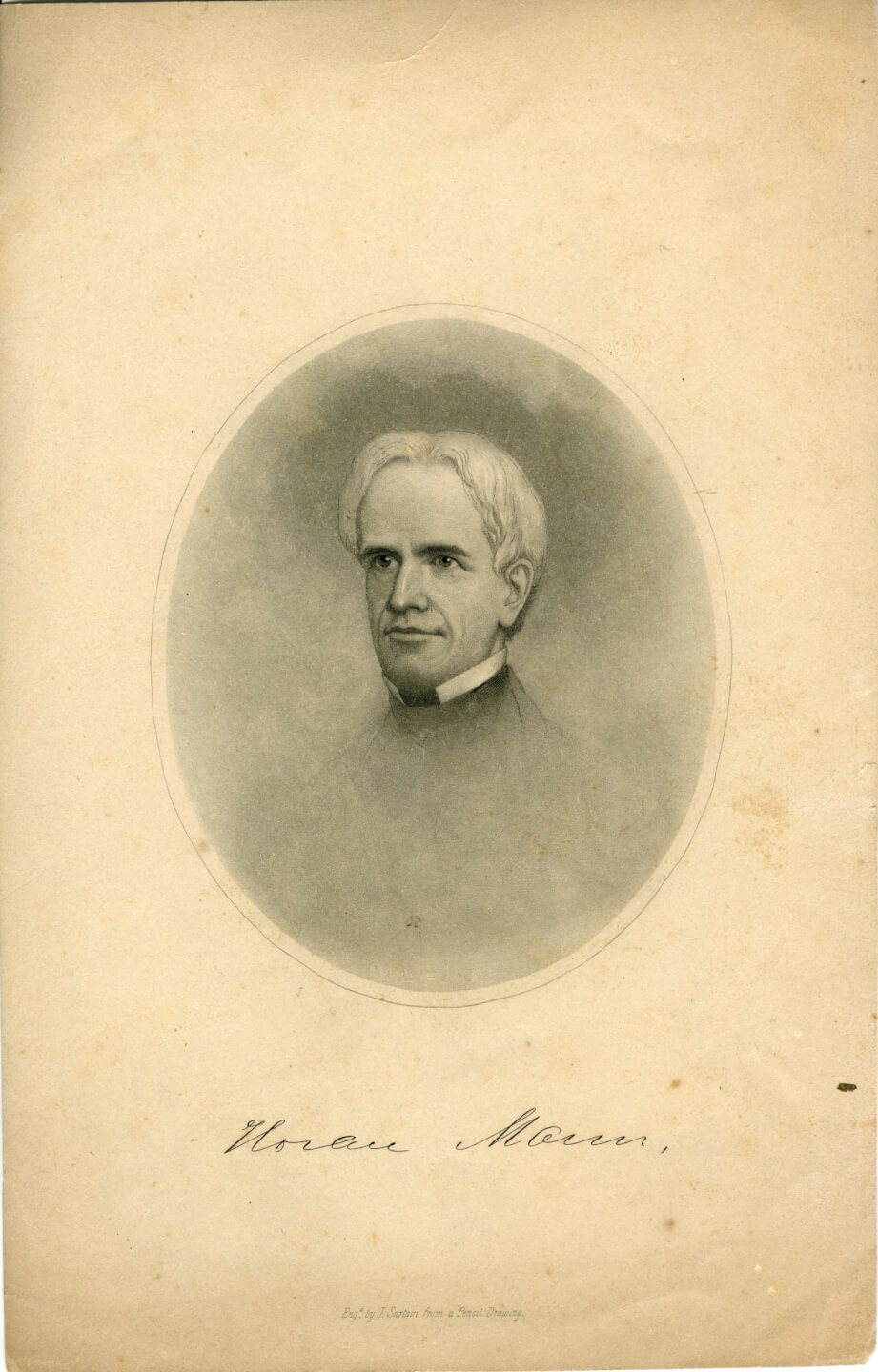
Horace Mann was a man of firsts. At least two of them, anyway. All Antiochians know he was the first ever president of Antioch College, but before that he was the first ever Secretary to the first ever state board of education (Massachusetts) in American history. Appointed to his post in 1836 after being public education’s most strenuous advocate in the State Senate, for the next twelve years Mann advocated for standardization of free and universal education for all Americans. Mostly his work is documented in his 12 Annual Reports on Education, much of which largely form the basis of public education in the United States. Another of his duties was to edit a monthly publication, The Common School Journal. What follows is most of his editorial from the first issue for 1848, and perhaps the only instance of Mann delivering a holiday greeting in print.
THE
COMMON SCHOOL JOURNAL.
VOL. X. BOSTON, JANUARY 1, 1848. No. 1.
A HAPPY NEW YEAR TO ALL ! A reformed life to those who have led a bad one ; and a better life, even to those who have led a good one. Where Ignorance has heretofore presided, may Knowledge hereafter reign ; and where Folly has held her courts, may Wisdom hold her councils.
We propose to renew, for another year, the relation heretofore subsisting between our subscribers and ourselves. It seems unnecessary, however, on this occasion, to enter into any detail respecting our purposes and our plans. Those who know the history and character of the Journal for the last nine years, know our objects; and they know also the fidelity and the success, or the want of them, with which those objects have been pursued. It would be easy for us to expatiate in hope-inspiring words, to become exuberant in professions and promises, with regard to our future course ; but words are, at best, but buds and blossoms, while deeds alone are fruit. Our efforts during the past, must be accepted as the guaranty of our endeavors for the future.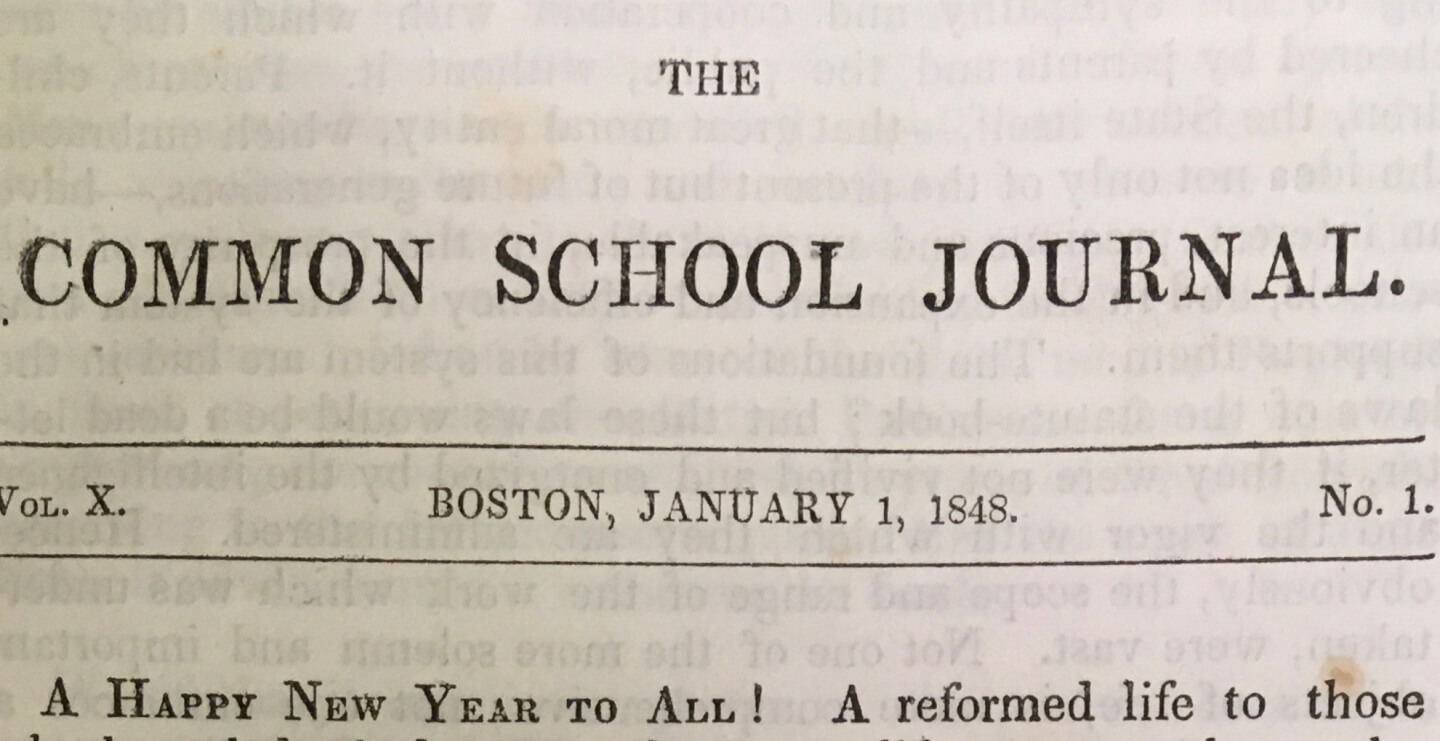
The publication of the Common School Journal was not undertaken for any partisan or sectional object, but to promote the great cause of Popular, or rather, Universal Education. Hence, all the interests connected with this grand movement,—-the greatest movement of modern times,—have come legitimately within its purview. This has necessarily opened a wide field for inquiry; but it is a field no part of which could remain unexplored, without causing most serious deductions from the value of the survey. The State, and the municipal corporations into which it is divided, are primarily interested in the partition of our territory into districts. On districts, generally speaking, devolves the pecuniary responsibility of erecting schoolhouses. The legal voters of the towns, each for itself, elect the superintending school committees. Committees grant or withhold certificates of approval, when sought for by candidates for teaching. The labor of teachers is rendered more or less irksome and arduous, and is more or less successful, according to the means and appliances for instruction, which are placed at their command, within the schoolroom ; and according to the sympathy and cooperation with which they are cheered by parents and the public, without it. Parents, children, the State itself,—that great moral entity, which embraces the idea not only of the present but of future generations,—have an interest, precious and unspeakable, in the prosperity of the schools, and in the expansion and efficiency of the system that supports them. The foundations of this system are laid in the laws of the statute-book; but these laws would be a dead letter, if they were not vivified and energized by the intelligence and the vigor with which they are administered. Hence, obviously, the scope and range of the work which was undertaken, were vast. Not one of the more solemn and important objects of life, is more comprehensive ; not one embraces a greater variety and extent of detail. With such ability as we could command, we have endeavored to make the Journal fulfill the purpose that originated it. As its pages have been enriched, from time to time, with the productions of some of the best minds in the country, we feel a higher degree of confidence, that those who have intelligently perused it from the beginning, do know something on the subject of Common Schools, and of the best means and methods of sustaining and conducting them, and of the priceless value of education.
 Taking a brief retrospect, we may say, that the previous volumes of the Journal contain every law of the State, now in force, respecting Public Instruction, together with a complete digest of those laws, and the decisions of the civil courts interpreting all their leading provisions ; they contain, in full, all the Reports of the Board of Education, since its establishment ; a history of the origin, progress and success of the State Normal Schools ; model plans for schoolhouses, with directions specific and detailed, as to the best methods of constructing, seating, furnishing, warming and ventilating them ; copies of school registers and of committees’ returns, by which the statistics of the schools are obtained,—a system believed to be more extensive and exact than exists in any other part of the world ;—assays and extracts from the ablest educators and educationists, on the subjects of school order and school, discipline, and on the best methods of teaching each one of all the Common School branches articles original and selected, of a moral literary and scientific character ; with passing accounts or notices, of the condition, the prospects or the progress of education in other States of our own country, and in other parts of the world.
It is this comprehensiveness in the plan and scope of the Journal, which has given to it one of its distinctive features. There is no other educational Periodical in this country, or, so far as we know, in the world, which has proposed to itself the same end. Coupled with the well-deserved celebrity of the Massachusetts school system, it causes the Journal to be sought after by almost every State, city, or community of any size, which proposes the establishment of a Common School system. Many systems have been modelled, in all their substantial details, according to our plan ; and it affords us pleasure to add, that there is at present, in the rich and populous, (though also poor and degraded,) county of Lancashire, in England, a general movement, led on by some of the ablest men in England, in favor of petitioning the British Parliament for a charter, empowering the county to establish a system of Free Schools, according to the Massachusetts plan. May the cause of Free Schools advance until it embraces the earth.
Would that it were in our power, on the present occasion, to compose an anthem worthy of the glorious cause of Education. Would that we could adequately describe her might and majesty, when she goes forth, like a puissant goddess, and speaks deliverance to captive nations from their hereditary and long-transmitted bondage to ignorance ; when she drives away, by myriads, the vampires of superstition, that have sucked the life blood from the hearts of men; when she turns wildernesses and jungles into habitable lands; when she takes the crude and apparently intractable substances of the earth, and turns them into the thousand fold implements of the useful arts, and into all the every-day comforts and conveniences of life ; when she makes indocility docile, and changes tribes of wandering and houseless savages into happy, home-loving and home-possessing families; when she teaches her disciples that obedience which wards off diseases and pestilences, and makes their days long in the land; when she propels ships across the ocean, speeds locomotives over continents, rears temples, prints libra¬ries, turns the lightning into a vehicle of thought and builds for it an aerial railway, to increase its celerity and fix its destination ; and when she instructs us how to wrap in unconsciousness each of our millions of nervous filaments, so that we can resist, like a rock, every arrow of pain. It is indeed glorious to contemplate education in these sublimer manifestations of its power. But scarcely less interesting is it, to trace out and examine any single operation of her divine skill,—to see how she can rescue an individual, as well as reform a State; how she can console and bless the poorest and most forlorn wretch upon the earth, as well as ennoble and aggrandize a world. Education is as great in her minutest as in her mightiest operations.
Let us, at the present time, follow the footsteps of Education,—not in one of her grand progresses, where she displays her trophies to the world, and challenges the admiration of mankind;—but let us accompany her in one of her silent and as yet almost unobserved walks, as she goes to visit the most hopeless and dreary abodes of the earth, and there make known the beauty and tenderness of her maternal ministrations.
“Songs From the Stacks” is a regular selection from Antiochiana: the Antioch College archives by College Archivist Scott Sanders.


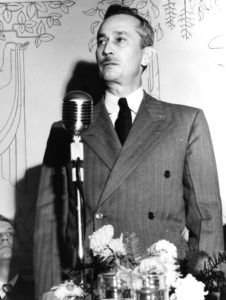 Algo Henderson delivered the following address at the 1935 Alumni Dinner, he was concluding his second year as interim president, filling in for Arthur Morgan who was away building dams for the Tennessee Valley Authority. Here one of the more articulate commentators ever on Antioch College addresses among other subjects, the College as sailing vessel, perhaps a natural metaphor for institutions of higher learning. Most striking in this address is Henderson relating his visit to the cathedral of Chartres to the often elusive concept of ideals, and how one person’s experience informs perception in a most individual and particular way. In this way, he suggests that no two people are likely to agree on what the specific ideals of Antioch College are, although they may have similar interests and goals, because of the powerful influence of experience upon impression. Also that ideals, even when written down and agreed upon, are in a constant state of change. Interestingly, even before the Antioch Civil Liberties Code was conceived, Henderson emphasizes freedom of expression as perhaps the highest of ideals, or at least the vehicle that carries us closer to realizing them. And while he delineates the contributions toward ideals made by faculty, students, and alumni, he concludes that all must work in concert if those ideals are to be strengthened. Some things never change.
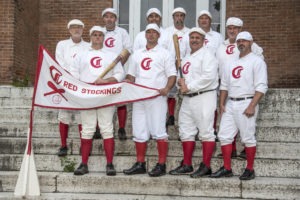 It took just a century and a half for Antioch College to finally make up its historic rainout with the Cincinnati Red Stockings. Though Antioch lost the game 14-7, it was an exciting back-and-forth affair tied at 7 after seven innings. Originally scheduled for 31 May 1869, the game was to be a launching pad for the first professional baseball team’s grand tour of Eastern States, designed to demonstrate to more established coastal cities that Cincinnati was equal to them by any measure. Because the president of that team was an Antiochian, the tour would begin in Yellow Springs where he had gone to school. So significant was this tour that a newspaper reporter, Harry Millar, was assigned to travel with the team; the first of his articles from the trip is reprinted below.
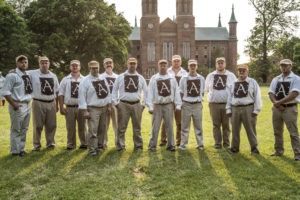 demonstrates that the baseball glove is one of the greatest inventions in the history of sport. It was played by enthusiasts that keep the vintage game alive under the auspices of the Vintage Base Ball Association. Established in 1996, the VBBA dedicates itself to “representing the game of base ball as it was actually played in accordance with the rules, equipment, uniforms, field specifications, customs, practices, language, and behavioral norms of the period.” The 1869 Red Stockings club formed in 2000 and had been eyeing this date at Antioch College for some time. Since the College hasn’t played an intercollegiate baseball game in about 90 years, the Champion City Reapers of Springfield played the part of the Antioch Nine. For added authenticity, the Reapers buttoned old English “A”s to their uniforms based on the famous team photograph taken by James Landy of Cincinnati in 1869.
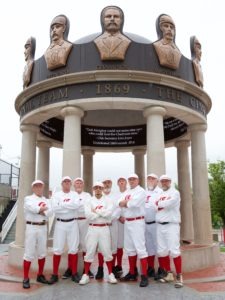 Antioch baseball more than once as dedicated readers have surely noticed. The Antioch connection to the early history of the game has been one of the College’s more cherished legends ever since May 1869 when it hosted what amounts to the first professional rainout. A century-and-a-half later, that cancelled game will finally be played by two vintage baseball clubs on May 31, with the Red Stockings of Cincinnati playing themselves and the Champion City Reapers of Springfield representing the Antioch Nine.