
Yellow Springs Review 19 June 1896 – Antioch College

Yellow Springs Review 19 June 1896

Home » Campus News Latest » Antiochiana: Songs From the Stacks » Yellow Springs Review 19 June 1896

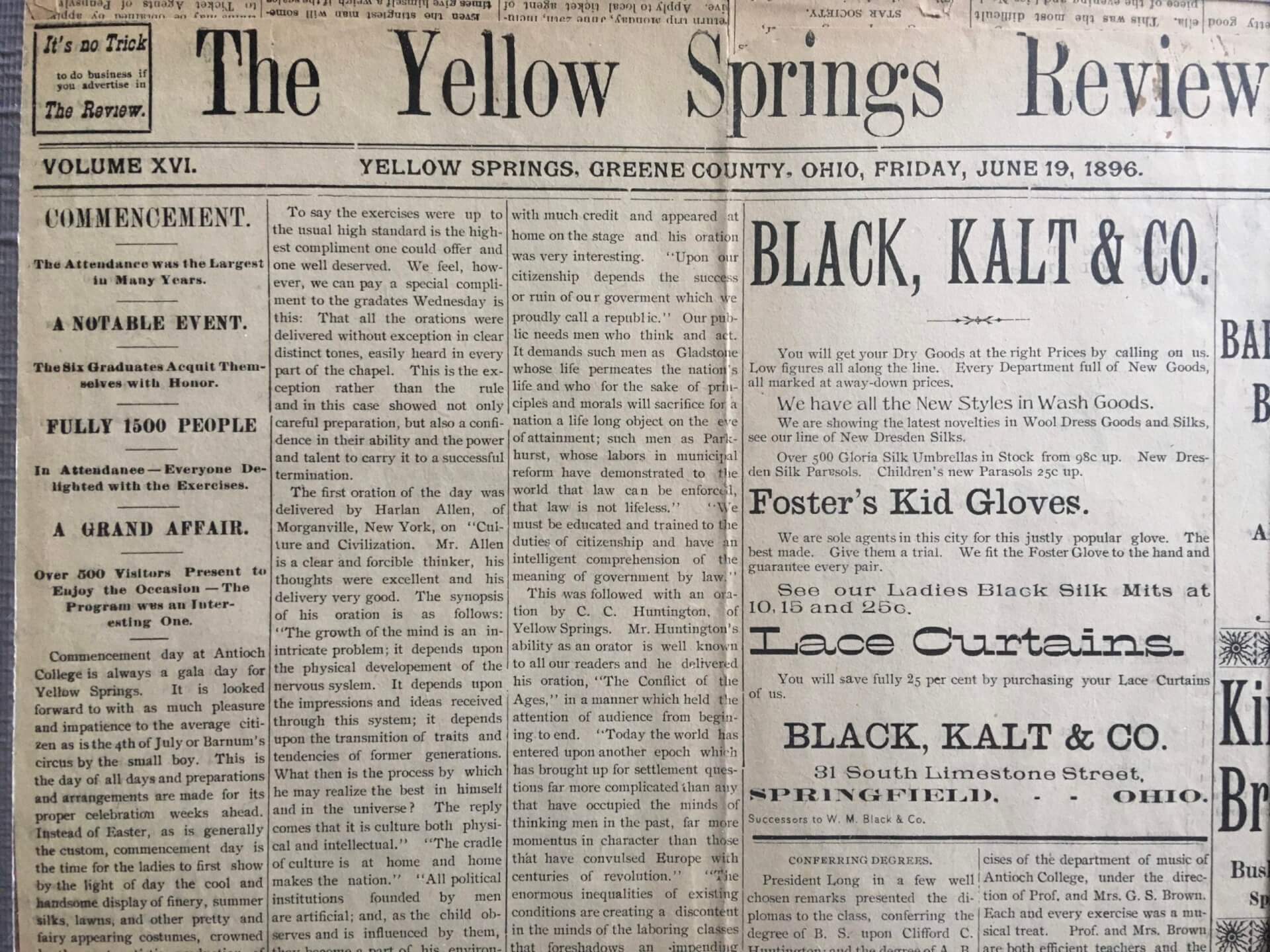
No one, it seems, got as much fun out of an Antioch College Commencement as the local newspaper did. That is if the following article from the Yellow Springs Review is any indication. Their coverage of the graduation exercises for 1896 was spread across two nearly full pages, with no detail spared no matter how trivial.

Amid descriptions of the decorations and plaudits for what a nice job everybody did and pronouncements of biggest and best commencement ever are the substantial things said by the graduates that day. Some of the orations by members of the Class of 1896, for instance, address still relevant subjects. John Mitchell Davidson emphasizes the importance of truth to the pursuit of statecraft. Warren Denison’s “An American’s Highest Duty” says that it is the citizens of a republic that make a republic, and that it is their responsibility to ensure that it has proper leadership and dedicated reformers such as England’s longest serving Prime Minister William Gladstone and Reverend Charles Henry Parkhurst, a Presbyterian minister who in 1892 took on corruption in New York City’s machine government and its lawless police department. Clifford  Huntington’s line “Labor will not always submit to to be the slave of capital,” complete with an extra “to” in the original print (reprinted below along with all the other typos), goes well with any number of things overheard during the protests of June 2020.

Noting the presentation of Bibles to the class by “Hon. F. A. Palmer,” 1896 woud be one of the last years that Antioch had an official relationship with an ecclestiastical body. Palmer, one of the founders of the College and an early hero of its fabled financial history, was a banker who wanted to cement its ties with the Christian Church for all time, going so far as to offer a “considerable endowment” in exchange for the resignations of twelve presumably Unitarian trustees at the Spring 1897 Board Meeting. Palmer’s plan would ultimately backfire on him a year later, when in 1898 Antioch’s long, ruinous history of denominational strife finally ended with the Board rejecting his ostensibly reliably Christian faculty appointments.
NOTES:

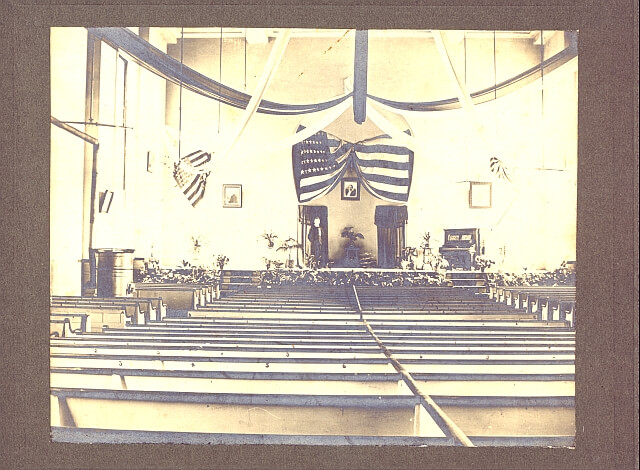
Image 1 – Chapel: Known as Kelly Hall since the early 20th century, the old College Chapel where the 1896 Commencement was held.
Image 2 – The YS Review for Juneteenth, 1896.

 from the Yellow Springs Review, 19 Jun 1896

Commencement day at Antioch College is always a gala day for Yellow Springs. It is looked forward to with as much pleasure and impatience to the average citizen as is the 4th of July or Barnun’s circus by the small boy. This is the day of all days and preparations and arrangements are made for its proper celebration weeks ahead. Instead of Easter, as is generally the custom, commencement day is the time for the ladies to first show by the light of day the cool and handsome display of finery, summer silks, lawns; and other pretty and fairy appearing costumes, crowned by the most artistic production of millinery, impress I the observer with an idea of holiday finery. Antioch, for the time being at least, is queen of the day. No prettier day could have been selected, even were such a thing possible, than last Wednesday, the date o’f the thirty-ninth annual commencement of Antioch College. The sun arose clear, and as early as 8 a. m. people could be seen wending their way towards the college, the mecca of the day, and by 9 o’clock a constant stream of pedestrians, bicycles and conveyances of different kinds were hurriedly proceeding toward old Antioch. One half hour before the exercises commenced the large chapel was well filled; still they came, until when the orchestra started to play the opening piece of music, every available space was taken and the last sweet strains of the march gently died away amid the applause of probably the largest commencement audience ever assembled in the historic chapel. While from lack of space, we are compelled to give only a condensed account of these exercises, we feel we must at least give a passing notice to the decorations.

The college motto, as usual, had its place in the center of the alcove on the stage, with the societies’ popular motto on either side-”Juncti Junant” of the Union on the right, with “Virtus Nostra Ducens Stella Est” arranged on a star to the left. 

A liberal display of floral decorations bordered the platform, while large and handsome ferns marked a line back of which was arranged places where sat prominent visitors and citizens. What attracted the most attention, however, was the arranging of the college colors, pink and blue, artistically draped in graceful folds around the walls of the chapel and with just enough of cedar decoration to give a pretty effect.

To say the exercises were up to the usual high standard is the highest compliment one could offer and one well deserved. We feel, however, we can pay a special compliment to the gradates Wednesday is this: That all the orations were delivered without exception in clear distinct tones, easily heard in every part of the chapel. This is the exception rather than the rule and in this case showed not only careful preparation, but also a confidence in their ability and the power and talent to carry it to a successful termination.

The first oration of the day was delivered by Harlan Allen, of Morganville, New York, on “Culture and Civilization. Mr. Allen is a clear and forcible thinker, his thoughts were excellent and his delivery very good. The synopsis of his oration is as follows: “The growth of the mind is an intricate problem; it depends upon the physical developement of the nervous syslem. It depends upon the impressions and ideas received through this system; it depends upon the transmition of traits and tendencies of former generations. What then is the process by which he may realize the best in himself and in the universe? The reply comes that it is culture both physical and intellectual.” “The cradle of culture is at home and home makes the nation.” “All political institutions founded by men are artificial; and, as the child observes and is influenced by them, they become a part of his environment; when, standing  on these ideals of his ancestors, he is able to weigh their defects in the balance of a more cultured brain, and to proclaim to the world a new ideal, then the ignorant populace throw stones and light and darkness struggle for the mastery,” “Thus we see that the institutions of a people depend for their character upon the degree of culture possessed by the masses.”

The next oration was by John Mitchell Davidson, of Xenia, Ohio, who handled his subject “Truth” in a very entertaining manner. He appeared wholly at ease speaking gracefully with every indication of complete at-homeness with his subject. “In the accumulated products of a world’s industry the present generation finds that upon which it must base its growth or retrogression. How then the choice of truth is made from its rightful heritage, with what clear sighted and sure intelligence the intellect is trained to distinguish right, in this lies the entire problem of culture. It is that which makes great leaders, great poets, great statesmen.” But not alone individual truth and purity is demanded. It is necessary for the welfare of every community that the public conscience also be educated. It is necessary that the state think and act for itself, even as it is necessary for the individual thus for himself to think and act, and when truth is finally apparent through such centralized or combined effort, no power is able to withstand it.”

After a very beautiful trombone solo by Mr. Clarence Lafferty of Springfield, which was greatly enjoyed by the audience, we listened to an oration on “An American’s Highest Duty,” by Warren H. Denison, of Hunter’s Land, N. Y. The gentleman acquitted himself with much credit and appeared at home on the stage and his oration was very interesting. “Upon our citizenship  depends the success or ruin of our government which we proudly call a republic.” Our public needs men who think and act. It demands such men as Gladstone whose life permeates the nation’s life and who for the sake of principles and morals will sacrifice for a nation a life long object on the eve of of attainment; such men as Parkhurst, whose labors in municipal reform have demonstrated to the world that law can be enforced, that law is not lifeless” We must be educated and train to the duties of citizenship and have an intelligent comprehension of the meaning of government by law.”

This was followed with an oration by C. C. Huntington, of Yellow Springs. Mr. Huntington’s ability as an orator is well known to all our readers and he delivered his oration, “The Conflict of the Ages,” in a manner which held the attention of audience from beginning to end. “Today the world has entered upon another epoch which has brought up for settlement questions far more complicated than any that have occupied the minds of thinking men in the past, far more momentus in character than those that have convulsed Europe with centuries of revolution.” “The enormous inequalities of conditions are creating a discontent in the minds of the laboring classes that foreshadows  an impending revolution.   Labor will not always submit to to be the slave of capital. History teaches us there can be but one outcome to this struggle. Despotism again will fall and the indomitable forces of freedom win another victory.”

This was followed with a selection by the orchestra and then Stephen Gideon Palmer, of Medway New York, delivered a fine oration on “Trinity.” “Would we be strong physically, it is necessary to exercise the muscles of the body. Would we acquire mental attainments, it becomes necessary to to exercise the intricate nerve fibers of the mind. Would we hold in our grasp moral or spiritual power, then there rests upon us the obligation of bringing into use the capabilities of the soul. Thus shall we be able to give to the world by means. of exercising body mind and soul, a development of this trinity that will place all at the goal of happiness. Then let him who would grow along the line of perfection, unfold with careful attention these elements of his nature; remembering that perseverance is the key that gives true honor and renoun to well developed manhood.”

The closing oration was delivered by Miss Estelle Tufts of Yellow Springs, who was the only lady of the class. Her subject, “The American School of Dialect” was presented in a cheerful and graceful manner, containing  a brief sketch of American dialect writers and the impressions they have made upon the minds of the people during the present century. Miss Tufts is an interesting speaker and reflected great credit on the college by the admirable manner in which she delivered her oration. The orations of the graduates are published in the June number of the Antiochian and all should read them.


CONFERRING DEGREES.

President Long in a few chosen remarks presented the diplomas to the class, conferring the degree of B. S. upon Clifford C. Huntington; and the degree of A. B. upon John Mitchell Davidson, Warren Hathaway Denison, Steven Gideon Palmer, Harlan Allan and Mary Estelle Tufts. Hon. F. A. Palmer, of New York, then presented each member of the class of ‘96 with a copy of the Bible, the last and best gift Antioch could make them.

After singing the well known hymn “Antioch” the audience was dismissed with the benediction by Dr. McCoubray, of New York.


COMMENCEMENT DINNER.

The commencement dinner followed the graduating exercises and nearly 300 persons sat down to a bountiful repast in the College Dining Hall. After dinner a number of good speeches were made by members of the Board of Trustees Faculty, and prominent guests present. All expressed themselves as more than pleased with the commencement and the outlook for Antioch is now brighter than ever before.

In the afternoon the Antioch Alumni held a very interesting meeting in the college library and work was planned to raise funds to endow a “Horace Mann Chair” at Antioch.

The Star Alumni Association also held a meeting in the Star hall Wednesday afternoon which was very interesting and greatly enjoyed by all present.

At 4 p. m. Wednesday, a large number of the Union Society members and the Union Alumni assembled in the Lecture room and appointed a committee to arrange for a re-union of the old and present members of Antioch Union Society to be held on the afternoon of Commencement Day 1897, in Union Hall.


MUSICAL RECITAL.

In the evening occurred the musical recital and graduating exercises of the department of music of Antioch College, under the direction of Prof. and Mrs. G. S. Brown. Each and every exercise was a musical treat. Prof. and Mrs. Brown are both efficient teachers and the fine work of their pupils must have been as gratifying to them as it was pleasing to the large audience in attendance. The program was as follows:


Piano Duo—March des Jeunes Dames, Goldbeck, Misses Miller and Middleton.

Piano Solo—a. Sonatine Op. 20. No. 3 Larghetto, Kuhlau; b. Alpine Horn, Schrimer, C. A. McDaniels.

Vocal Solo — I Know That My Redeemer Liveth, from Handle’s Messiah, Lora C. Middleton.

Piano Solo—Fra Diavolo…………..Smith

Floy Vent.

Piano Duo—Grand Valse de Concert, Mattei, Misses Little and Stewart.

Piano Solo—Priutemps d’Amour Mazurka, Gottschalk, Emma Southward.

Vocal Duo—I Heard a Voice in the Tranquil Night, Glover, Lora Middleton and C. L. Neibel.

Presentation of Diploma—Pres. D. A. Long.

Antioch Glee Club—The Bridge, . .Lindsay, Messrs. Brown, Neibel, McDaniels,Wills, Neibel, Davidson, Rinehart and Allen.

The music was greatly enjoyed by all. After the musicale the President gave a reception, where young and old, visitors and citizens thronged the large halls and had a good time generally. So ended the most successful commencement in many years.


HORACE MANN DAY.

Tuesday, the 16th, was given to the Alumni for the celebration of Horace Mann’s centenary. In the forenoon two excellent addresses were given, the first by Hon. William Bell, of Indianapolis, and the other by Dr. McWhinney, of Franklin, Ohio. Mr. Bell was a Horace Mann student and paid a glowing tribute of respect to his memory.

In the afternoon, Dr. J. B, Weston, of Stanfordville, N. Y., and a member of Antioch’s first graduating class, gave the address. This was an admirable address and such an one as Dr. Weston always gives. He was followed by an address by Thomas Charles, of Chicago, a Horace Mann student.

In the evening was the reunion of Alumni and friends, which was most delightful. The Glee Club and Union Quartette furnished excellent music. A goodly number of three minute speeches were given by members of the Alumni and trustees. Of these we must mention Miss Rice, the worlds of welcome of President D. A. Long, the speeches of Dr. Thayer, Jenkin Lloyd Jones, Mr. Bell, Mr. Tone and Prof. Well’s poem.

A number of letters were read and greetings given from old students who could not be present. It was a very enjoyable occasion. All regretted exceedingly that Dr. Edward Orton was prevented by the order of his physician, from attending and giving his address on account of his feeble health.


ANTIOCH UNION SOCIETY

The seventeenth anniversary of the Antioch Union Society opened at the chapel on Monday evening with a piano duo by Misses Lehow and Stewart. The young ladies did themselves great credit and received the applause of the delighted audience. Mr. Harlan Alen then delivered the president’s annual adress, which was listened to with the greatest interest and pleasure.

The eulogy, “Eugene Field”—”A Study in Humanity” was a well chosen subjecrt and well delivered by Miss Mae McReynolds. It was distinctly heard throughout the entire hall.

Miss Charity Judy then sang a very beautiful solo, after which Miss GEnevieve Little gave a “History of the Society” from the earliest times to the present date, recalling to many Alumni present the happy times spent in society work years ago. The paper was well written and very entertaining.

Mr. Herbert Judy presented a very interesting essay on training the Imagination which was worthy of commendation.

The “Geyser,” the society paper was full of bright and witty sayings and was greatly enjoyed by all. Miss Hazel Miller, the editor, aquitted herself with much credit.

Prof. G. S. Brown rendered one of his beautiful tenor solos. He has a beautiful voice and it is always a treat to hear him sing.

Miss Edith Neal recited a charming selection, entitled “To-morrow at Ten,” in her usual pleasing manner.   It called forth much praise.

  1. H. Dilworth closed the program with a fine oration on “Honesty.”’ The oration showed deep study and a thorough knowledge of his work.


ELOCUTION RECITAL.

The exercises of commencement week opened an elocution recital by the pupils of Miss Pearl Means. Miss Means is an excellent teacher, thorough and careful. Her pupils gave evidence of the thorough drill the have had. The “Ideal Orchestra” which was to have furnished the music for the occasion for some reason did not appear.

The program opened by Miss Gertrude Baker giving Robert Browning’s “Ratisbon” which was followed by Browning’s ‘Clive’ read by Miss Tufts. Both ladies read in a graceful manner to be commended.

The next was a scene from Hamlet, Mr. James Jones taking the part of Hamlet and Miss McDaniel that of Ophelia. Both persons acted well. Miss Julia Walker read in a pleasing way The Lord of Burleigh.

This was followed by a scene “The school from Scandal” which Miss Hester Shroads took the part of Lady Teazle and Mr. Albert Baker that of Sir Peter Teazle. In this Miss Shroads was perfectly at home, and Mr. Baker never impersonated better. Miss Grace Arthur in her usual charming way read Burdette’s, “Engineer’s Wooing.”

The second scene of “The scandal” followed.

Miss Edith Neal impersonating a Spanish gypsy girl gave Zingarella. This was the most difficult piece of the evening and Liss Neal, in her usual manner, captivated the audience.

The best production of the evening probably was the Shakespearian burleigh in which Mises Shigley, Forbus, McDaniel and Dudley took the parts of Juliet, Portia, Ophelia, and Lady MacBeth. All were perfectly at ease and acted well.

The program closed with reading, ‘The Marbel Dream,” by Miss Ethel Arthur. This was well rendered and given under colored light.


UNION SOCIETY DIPLOMA MEETING

The Diploma meeting of Antioch Union Society was held on Monday morning at 9:30 o’clock. The Diploma meeting, always interesting, was unusually so this year. All the performers were old or present members of Antioch Union.

The program opened with a piano duet by the Misses Alkire and Mellinger. This was well rendered and delighted all present.

Mr. Philo G. Burnham, ‘91, then gave an address on “Our Saxon Heritage.” This was replete with fine sentiment and good thought from beginning to end and deserves especially mention. Mr. Burnham is cordially welcomed back to ANtioch, and his host of friends were more than pleased to have the opportunity of listening to his fine address.

Mr. Lewis S. Hopkins, a present member, gave an excellent oration on the subject of “Crises.” Mr. Hopkins is a clear thinker and delivered his oration in a manner that pleased all.

Miss Annie Lehow, one of Yellow Springs’ best pianists, rendered a very charming piano solo, which was followed by an address by Prof. A. R. Wells on “Old Friendships.” It is needless to say that Professor Wells gave a very good address and he could not have chosen a more fitting subject. His “old friends” were delighted to have him present at this commencement and Antioch Union is proud to honor her Alumnus.

Miss Bertha Stewart present diplomas to the graduate members—Messrs. Allen, Denison, Davidson, Huntington and Palmer. Miss Stewart spoke with deep feeling and impressiveness and   her parting words to the graduate members will long be cherished by them.

Mr. Walter Wills closed the program by a song, “Ora Pro Nobis,” which was rendered in his usual fine manner.


STAR DIPLOMA MEETING.

On Monday afternoon the heavy rain kept many away from the Star Diploma Meeting, but those who were there were amptly repaid for going.

The first exercise was a piano solo by Miss Sallie Birch. This was well executed. Miss Birch is rapidly coming to the front as one of our first musicians.

Miss Arnetta Hopping, a last year’s graduate, read a very aceeptable paper on “Woman’s Missions.” This was followed by a reading, “The Deacon Wants a Place,” by Miss Anza Johnson. Miss Johnson appeared perfectly at ease and gave her production in a graceful manner. The Stars were then favored by an impromtu talk by Mr. Harrison Tone, of Texas. Mr. Tonei was a Star graduate thirty-seven years ago, and gave some pleasing reminiscences of college life in early days as well as a description of his chosen state, Texas. The Stars are always glad to welcome back old members.

Miss Lora Middleton and Mr. C.L. Neibel sang a soprano and tenor duo, which elicted much praise. This was followed by an addrees by Rev. S. D. Bennett, “The Remainder.” It was full of good thought. Mr. Bennett is a graduate of the class of ‘88 and was a faithful earnest worker while here in college. We are glad to have him back.

Mr. C. P. Pumphrey presented the diploma to the graduate member, Miss Stella Tufts. Mr, Pumprey gave a good address and spoke in an earnest, forcible manner.

The program closed by a vocal trio by Misses Clara Southward, Effie Middleton and Lucy Birch. This was sung in a pleasing manner.


STAR SOCIETY

The 40th Anniversary of the Star Society occurred Saturday evening June, 13th.

The progran opened opened with a piano duo by Misses Vent and Miller which was well executed.

President Miss Estella Tufts delivered the annual address, giving a general view of the society work and an interesting talk on the great benefit derived therefrom. The address was very appropriate.

The paper “A Great Man and a Great Book” by Miss Bessie Wiley was a well written review of Tom Brown at Rugby,

Nelson Clark read a very interesting essay on “Live while preparing to live.” His delivery was very good.

Miss Elizabeth Zahn delighted the audience with a very beautiful Soprano solo entitled “Magnetic waltz.” Her voice is clear, smooth and attractive. It is certainly a great treat to hear her sing. 

Mr. Charles Neibel then delivered oration on “Heridity.” The gentleman has a strong clear voice which could be distinctly heard throughout the large chapel. 

Miss Ethel Arthur recited “A Medley,” so admirably that it brought fourth great applause.

The Star Quartett then rendered “Annie Laurie” in a very beautiful manner and responded to the encore with another pleasing selection.

Among the many prominent guests who attended commencement this week we note the following::


Hon. J. Warren Keifer, Springfield;

Hon. William Bell, Indianapolis.

Miss Grace Shoe, Piqua Ohio.

Miss Pearl Troxell, Miss Maud Teazell, Plattsburg, Ohio.

Mrs. Rastinell, Bellefontain Ohio.

Mrs. Riley, Ridgeville, Ohio.

Mrs. Bailey, Troy, Ohio.

Miss. Irma Wilson, Fairfield, Ohio.

Miss Glotfetler, Xenia, Ohio.

Miss Rife, Columbus, Ohio.

Dr. and Mrs. Stewart, Cedarville, Ohio.

Mr. and Mrs. Miller, Geneseo, Ill.

Mrs. Thomas Brandom.

Miss Mary Flynn, Alcony, Ohio.

Miss Sadie Markley,  Bluffton Indiana.

Dr. W. C. Marshall, Mr. F. E. James, Dayton Ohio.

Miss Rice, Urbana,Ohio. 

Thomas Charles, Chicago, Ill.

 Miss Florence Seward, Spring Valley, Ohio.

Mr. and Mrs. J. B. Weston Stanfordville, New York.

Rev, E. A. DeVore, Merom, Ind. 

Pres. Aldrich, Merom Ind.

Rev. M. J. Miller, Geneseo, Ill.

Joseph Wilby, Cincinnati.

Miss Rebecca Rice, Chicago. 

Joseph Wayne, Cincinnati.

Hon. F. A. Palmer, New York. 

  1. Warren Weeks, Dayton. 

Hon. H. Tone, Dennison, Texas. 

Amos R. Wells, Boston. 

Hon. Geo. Arthur, Springfield. 

Mr, Eavey and wife, Xenia. 

Dr. W. A. Galloway, Xenia. 

Mr and Mrs. Andrew Bates, Irwin, Ohio.

Miss Katie Huntington, South Charleston, Chio.

Misses Meriam and Ruth Brigham, Chicago Ill.

Miss Jennie Wagner, Trotwood, Ohio.

Miss Mabel Arthur, Mrs. Emma Wilson, Springfield, Ohio.

  1. R. Glass, Columbus, Ohio.

Mr. Victor Weller.

Mr. and Miss Carrie Smith.

Miss Winter, Westerville Academy.

Many others were present whose names could not be learned.


“Songs From the Stacks” is a regular selection from Antiochiana: the Antioch College archives by College Archivist Scott Sanders.
 

More Songs From the Stacks

Wellington Peabody to Mrs. Elizabeth Peabody 22 Sep 1837 – Antioch College

Wellington Peabody to Mrs. Elizabeth Peabody 22 Sep 1837

Home » Campus News Latest » Antiochiana: Songs From the Stacks » Wellington Peabody to Mrs. Elizabeth Peabody 22 Sep 1837

After more than a month battling the New Orleans Yellow Fever Epidemic of 1837, the worst outbreak there in fifteen years, 20 year old medical student Wellington Peabody wrote to his mother. He relates grim details of the death toll on the city’s immigrant population, known commonly in New Orleans as “strangers”, assuring her of the measures he takes to see that he does not become infected himself, including doses of carbonate of ammonia, a forerunner of baking soda. Apart from caring for the patients in Dr. MacFarlane’s 100 bed hospital, he is also treating his brother George, who has come to town seeking work, for a discomfort in his spine he’d suffered from all summer. Wellington hopes the fall temperatures will stem the tide of the disease as had been the case in previous outbreaks.

In her tremendous triple biography “The Peabody Sisters: Three Women Who Ignited American Romanticism,” Pulitzer Prize winning author Megan Marshall explains that George Peabody is in the advanced stages of tuberculosis, another ailment completely baffling to physicians of the time. The spinal form of TB, one of oldest diseases known to humans (found in 5000 year old Egyptian mummies, for instance), outwardly manifests itself with painful abscesses on the spine that would account for the “issue” Welly has opened on his brother. George survived the epidemic swirling around him but not the tuberculosis, dying just two years later at age 26.

As with the letter to his sister, Wellington makes clear to his mother his goal to make a great reputation as an expert on Yellow Fever. Given his level of knowledge as well as the assumptions of the medical establishment in the 1830s, he can understand very little about it. His success rate at curing patients, impressive as it is, fails to consider the possibility that they may have recovered without his attention. As Megan Marshall wrote: “Yellow fever kills its victims quickly. Most patients well enough to reach the hospital would have survived anway, but Wellington didn’t know that.” Convinced of the transmission of sickness by miasmatic air, to avoid catching cold from the unpredictable weather he wears heavy clothes despite the late summer heat, not realizing that in doing so he also protects himself from mosquito bites he does not know to be infectious. Although Wellington knows that yellow fever historically abates in the fall and winter, the miasmatic theory cannot account for the contributing factor of a reduced insect population.

Without giving too much away, Wellington Peabody completed his letter home but someone else mailed it. The notations from its collector and transcriber, Robert L. Straker (class of 1925), indicate that someone, Straker doesn’t know who, has copied the original twice and added their own notations on one copy and some excerpts from George’s letters on the other.  His employer Dr. MacFarlane, grateful for Wellington’s attentiveness to his patients and the long hours he worked, seems a likely candidate.

Sept. 22, 1837.  Wellington Peabody to Mrs. Elizabeth P. Peabody.

(RLS)  Verso addressed: Mrs. Elizabeth Peabody, Care of Dr Nath’l Peabody, Salem, Massachusetts. Postmarked New Orleans, La., Oct. 6. 25

New Orleans, September 22, 1837

My dear mother,

     I am sufficiently astonished at not hearing from you since the 15th of last month, especially when your maternal feelings must have been considerably excited, by the dismal accounts which must have reached you eer this, about the terrible epidemic, now visiting this city. Terrible indeed, where from perhaps there have a precious few strangers escaped – one hundred have been dying daily for these three weeks past and though there is some dimunition in the mortality of the disease at the present time, it is not so much from the purity of the air and the removal of the causes of disease, as from the want of subjects, for them to act upon.  Amongst the great number of strangers residents of long standing, and even Creoles of the state, who have been attacked, and swept away – I have stood unscathed.  And although the oppressive weather has oftentimes exhausted me and made me feel unwell, I have escaped sickness, by attending immediately to any little symptom, which might degenerate into fever.  By the use of a little calomel, limewater, and carbonate of ammonia, and under God’s providence – I am now well and hearty.  George is here now, and has got into Gamble’s for awhile – for these three or four days past he has had some little fever – but is pretty well again.  I have opened an issue on his spine, and he has already felt some benefit from it – and I intend devoting much of my cogitations, to the peculiarities of his case – and hope in the course of five or six months to work a cure.  This winter, as soon as the atmosphere contains any electricity, I intend giving him two or three electric shocks daily – which will I hope benefit him much.  He lives very near me, and I see him two or three times daily.  The weather for the past week has been quite cool – and there has been considerable rain, and if these continue long enough, it will have a favorable effect upon the epidemic.  Indeed it has already done so.  Yet the unfortunate immigrants, who come here, come to the grave or to its brink, so dire is the pestilence.  The first frost will terminate it, which heaven send speedily.

     My labors here have been tremendous.  Our hospital, public & private case contain a hundred patients – and the private infirmary has been filled with yellow fever for this month past.  Of course, my duties have been arduous and constant in the extreme.  Too busy to be sick – I have also done a little something on my own account out of the house, and have had very good success in my practice.  If I collect what is due me, I shall get upwards of $300 – one hundred of which I shall forward to father and the rest I shall put in the bank – hoping to add to it gradually and bring home a decent sum.  I have made up my mind to construct a thesis, on Yellow Fever, for my graduating offering to the Massachusetts Medical Society – Its causes – its nature, its pathology, its treatment, in order, together with the topography of New Orleans – and its adaptation to miasmatic fever.  If I can carry out my idea, it will not be unacceptable to the Medical Society – since I shall develop the most rational practice – as proved by twelve years trial. Out of upwards of 120 cases in Dr McFarlane’s practice, during the present season – only six have died -.and the result of cases in this hospital has been equally favorable.  I myself have had a considerable number of patients say twenty and more and have lost but one, and this patient no one could have saved, for he had been long sick with intermittent fever, and could not bear up against the power of such a disease.  I would not try another summer for a kingdom.  It is a vile climate – no stability in it – Ever shifting – hot, dry, cold, moist, in rotation, & in one day. I wear thick winter clothes and flannels throughout – Having no notion of being imposed upon by such a humbug state of weather.  If I roll down rivers of perspiration part of a day, I do not freeze the rest of it – and I therein am safe, and never caught unprepared.

     No letter from Mary Bordman yet – but I do not despair and shall not, till the verdict comes from her own lips.  I can enter into her case, and forgive every want of mental strength – and shall require little, till I come back next summer – which I shall do, the first of August next, if I live so long.  I intend writing again to her in a day or two.  I shall continue to do it, till I return.  For I know that she will be glad to hear from me even if she has not courage to give me an answer.

     After the month of October there will be little sickness except as much as is usual in all places.  I shall have a little rest, for I have been working from daylight till eleven o’clock, during these five weeks past – and have had little time to refresh myself or read regularly, any medical book – and I must read much this winter and collect matter for my thesis for I must try to get some reputation – and if my production is what it should be, it will be printed in some of the journals.  Give my love to all, and tell me how things prosper with you.  I hope Sophia, poor thing, is doing well – and Nat – and all. My heart yearns for New England – its pure air, its glorious forests, & farms – its morals so pilgrim-like – who knows the value of home, but the poor fellow who dwells amid strangers – and sees no kindred spirit – enjoys no kindred associations!  “There is no place like home.”

     If George has any thing to say – I have left him little room.

Yrs affectionately
Wellington

NOTES:

Two copies, in an unknown hand, are with the original. One has this notation; “This was written 22 Sept. He was taken sick the 24 & died the 29 Sept 1837.”  The other copy has these notations:

The above was written on the 22, probably on the evening of Friday – He was taken sick on the next Sunday morning & died on Friday morning 29, 2 oclock.

Extracts from George’s letters

Sept. 28.  Wellington had some patients himself & did not practice the good advice he gave me, but exposed himself considerably…He is the greatest possible favorite with all the sick in the Hospital & appears to me to fill his place admirably.

Sept. 30.  He died universally regretted by all the sick, to whom he had been remarkably attentive & kind.  He is a loss that Dr McFarlane will find it difficult to supply.

Oct. 22.  One of the physicians at the Hospital thinks the immediate cause of his taking the fever was at the postmortem examination of a subject which died of it, 15 or 20 hours after death.  He handled it with great freedom & was finally dissuaded from pursuing the examination by the other physician who had had the fever & yet was taken sick, as was also a negro man who assisted.  Wellington worked very hard in the Hospital.  It is capable of containing 100 patients & he had to look after the comforts of all of them & give them their medicine & mix it besides.  They were all much attached to him & he had gained the esteem & approbation of a number of other physicians who frequented the Hospital.  I heard Dr McFarlane speaking of him in the highest terms to Parson Clap for his zeal in his profession & his devotion in coming out here in the midst of pestilence.


Image: “The New Orleans Charity Hospital” from Harper’s Weekly, September 3, 1859, via archive.org


“Songs From the Stacks” is a regular selection from Antiochiana: the Antioch College archives by College Archivist Scott Sanders.
 

More Songs From the Stacks

Some History of Div Dance – Antioch College

Some History of Div Dance

Through most of the 20th century and up until Antioch University closed the College in 2008, time at Antioch was marked by “divisions.”

A creation of Arthur Morgan’s Antioch in the 1920s, divisions were an expedient but fairly brilliant way to expand the student population without having to do the same to the physical plant. Designated “A” and “B,” two halves of the student body alternated between study in the classroom and working a cooperative education job. For students, the implications of this arrangement were twofold: Antiochians were unlikely to meet half of their graduating class until the year they graduated, and while you were on your co-op job, someone else was sleeping in your bed. A third division, called “C” and “C-Special” doesn’t really factor into our story, but gets brief mention nonetheless. 

With Anioch’s penchant for abbreviation and acronymity, “Divisions” soon became known as “Divs,” heading off to Co-op became “Div-Change,” and the biggest social event of the season became directly associated with divisions in a beautifully brief bit of two syllable alliteration: “Div Dance.” The student handbook collection in Antiochiana, once called “A Books” and later “Survival Guides,” helpfully note change over time. Antiochians of the late 1920s, most of whom had no idea that the Old College had prohibited dancing until very recently, looked forward to the Fall Dance, Spring Dance, something called the Bowery Ball, and Junior Prom, mandated in the “A” Book to be held the fourth Saturday of each Division, then a period of just five weeks. Guidelines for 1931-32 specified a report on the event submitted to Community Government within four days. By the time the “A” Book for 1940-41 came out, the term Div Dance was in general enough usage to appear in the Antioch Glossary found at the back and defined as “Formal division dance, when we hang blue curtains in the gym and get into our best clothes.” That it was a formal event is underscored in the section of the same edition “What To Bring.” For women it explicitly recommends “formals – preferably two; spring and winter, for div dances.” For men, it suggests rather broadly that “a Tuxedo is a good thing to have.” The formality of Div Dance waned over the last half of the 20th century, as it did at the College, but many an Antiochian still got dressed to the nines long after it was no longer a requirement.

To emphasize what a big deal Div Dance once was, it appears in both feature films about Antioch College. Near the end of the original Antioch Adventure, Mary Lou Merriwether waits by the PBX phone for her Derwood Raintree Jr. to ask her to be his Div Dance date. The scene is equally memorable for members of the Antioch Faculty bounding about in full counterculture regalia as the house band. In Antioch Adventure II, Div Dance is themed “Come As Your Parent’s Worst Nightmare.”

Don’t let this bland administrative history of Div Dance deter you from “attending” this year, and have a virtual blast!


“Songs From the Stacks” is a regular selection from Antiochiana: the Antioch College archives by College Archivist Scott Sanders.
 

More Songs From the Stacks

Letters from a Yellow Fever Epidemic, New Orleans 1837 – Antioch College

Letters from a Yellow Fever Epidemic, New Orleans 1837

Home » Campus News Latest » Antiochiana: Songs From the Stacks » Letters from a Yellow Fever Epidemic, New Orleans 1837

Stacks sings a pretty long song this month, but hey, we’ve all got a bit more time to read these days. Historians rightly claim the three Peabody sisters – Elizabeth, Mary, and Sophia – as leading intellectual figures of mid-19th century America; the Peabody brothers – George, Nat, and Wellington – not so much. Wellington, “Welly” for short, was perhaps Dr. Nathaniel and Mrs. Elizabeth Peabody’s greatest disappointment. The family expressed their worries about him as early as the age of six, when Mary wrote to her sister of him, “literally ruining at home. He is idle, lazy, & grows more uneasy at restraint every day.” Still, he showed enough promise and capability that his father went to considerable lengths to get him the education the Peabodys hoped would unlock his potential.

Admitted to Harvard at age 15, Welly discovered a love of gambling and a taste for fancy clothes, both incompatible with his family’s perennial financial difficulties. He left school after one semester, the first member of his class to do, deeply in debt thanks largely to his newfound habits. Hoping to make a man of him, his parents signed him on to the whaling vessel Hector, from which he jumped ship during a stop in Rio de Janeiro. After charming his way back to Boston, he claimed to his eldest sister Elizabeth that he’d been whipped for not working while sick with scurvy and the other sailors were a bad influence on him, but she confided she already doubted the veracity of his stories.

Determined to have a profession, at age 18, Wellington decided on a career in medicine, specifically to study infectious disease. Enthralled by the first-hand account “Cases of Cholera Collected at Paris,” published in 1832 by Dr. James Jackson Jr., he’d concluded that the easiest path to eminence lay in assiduously studying infectious disease while heroically combatting its effects. Apprenticing himself to a Salem physician, he planned to study in Paris as Jackson had done, learning French from his sister as part of his preparation.

The summer of 1837 gave Wellington his chance to duplicate Jackson’s feats, but not in Paris. An epidemic of yellow fever had broken out in New Orleans, a city ravaged by such plagues throughout the 19th century. There he found a job with a doctor named MacFarlane, treating yellow fever patients in a small private hospital.

One of the world’s busiest ports, New Orleans was also on the Middle Passage of the international slave trade, which is likely how a virus mainly transmitted by a mosquito native to Africa took hold there. Physicians of the day, Wellington included, believed instead in the “miasmatic theory” that held disease to be the product of heat, moisture, and decay such as occurs in the swamps of Louisiana. They may have been partially correct, given that such conditions tend to breed mosquitoes, but the direct connection to insect bites was not posited until 1848, incidentally by an Alabama surgeon also known for racist pseudoscientific theories to justify enslavement of African Americans. 

Antiochiana holds two letters Wellington Peabody wrote from New Orleans. In the first one to Elizabeth, he reacts to a meeting she had with the guardian of Mary Boardman, a wealthy Charlestown, MA, heiress to whom he had recently (and secretly) proposed marriage. Despite doubts she had about her brother, Elizabeth had agreed to act on his behalf and seek the man’s blessing for the union; she had already told her other brother George that for this to happen, Wellington would have to complete his studies and “continue to behave himself,” indicating something of his reputation back home.

Wellington’s detailed description of his new life in New Orleans clearly shows how badly physicians of the 1830s understood epidemiology. His ambition to impress the folks back home and make a name in his chosen profession and the story he tells about curing a patient mirror the heroic approach that physicians took to medicine at the time. He later comments about how he can only bathe infrequently, highlighting the fact that Western doctors did not yet see the need to wash up as a critical component of treatment (nor would they for decades to come). Sandwiched in between is an almost off-handed remark about possibly getting extra work supervising the enslaved crew of a cotton press, a large, mule-powered machine used to bale cotton for shipment. It seems unlikely that Wellington has the requisite experience for such work, and this may say something about the skill level of enslaved people such that they probably require little or no supervision to do their job.

Despite his recent considerable experience, Wellington is no closer to understanding yellow fever than the authors of the books he dismisses on the subject. He uses calomel, a mercury-based curative that in fact cured little, in the so-called “heroic” dose of 20 grains as prescribed in the 1790s by Dr. Benjamin Rush, a strong proponent of bloodletting. Due to its harmful effects, the Surgeon General banned its use in Army hospitals during the Civil War, but it would nonetheless remain popular into the 20th century.

August 31.  Wellington Peabody to Elizabeth Peabody (Addressed: Miss Elizabeth P. Peabody, Salem, Massachusetts, Care of Dr. N. Peabody.  Postmarked: New Orleans, Sep 1.)

New Orleans August 31st 1837

Dear Elizabeth

     Your letter of 13th Instant case to hand yesterday with its bitter and sweet commingled – and contrary to the usual custom I will begin to answer it from the end and so on to the beginning.  What a desperate old unsentimental matter of fact, jealous, impertinent old confirmed Bachelor, Mr. A. is.  He has n’t the minutest particle of an idea, about the curiosities of love – Its ups and downs, its crooked current, its trials, & its indomitableness.  He does not seem to know that this everlasting opposition merely strengthens the bond of union between Mary and myself, and forms stronger than ever, the determination in me never to give up the ship.  Your news would make me very uneasy, had I not the most perfect faith in Mary – so much, that if we both live another year, I have full hope of bringing the affair to an issue of eternal union.  I have written to her twice and have a right to an answer eer this – and I shall, as you say, persist in writing – but I do not agree to the proposal of directing to the care of Mr. Adan. Because why? You say that he has imbibed the notion that the motive of our action – is gold – he has evidently got a very unfavorable opinion concerning me – he is severe and moral in his ways – he is prejudiced against you especially – and George Hillard says his prejudices are inerradicable.  Therefore if he would insult a lady by gross and ungentlemanly insinuations – he probably would send a verbal bullet through my skull – and as it is now evident that Mary will not be strong in spirit, until the grand crisis of my return – and until she has infused into her some of my energized determination; I am of opinion that it will be better to let the ruffled waters subside – by withholding entirely the elements of commotion.  I have no doubt but that she will write to me – and if she does I shall be perfectly satisfied for the present. Would that she might energize, with half the power of the heroine – of the modern Philosophers – and every thing would be well now.  But that will never be. I am very happy to hear that she is rosy and happy. So long as her body is well – her mind will be susceptible of improvement and after what has passed we know well the actual state of her feelings with regard to me. Meantime I will write every three weeks to her, and when I get an answer from her I will inform you.  Thank heaven, my urgent duties preclude the possibility of much solitary cogitation on the subject. I left a letter of introduction with W. C. Tyler – and his gentle manners and great interest in the affair will stimulate him to look sharp after her welfare and my wishes. We must trust the result to time – and when another year has passed this tremendous affaire du coeur will be brought to an end – which will be like unto a beginning.  I hope that whenever you hear any thing of interest, you will inform me of it. Be it weal or woe. There is too much interval between your letters – write oftener.

     The weather is terribly warm – thermometer standing at a hundred in the shade – and so it has been this month past – no rain at all. The river has fallen greatly – more than has been known these ten years. Perspiration streams from me incessantly.  The evenings are cool and reviving – but it is necessary to put on a thick coat and guard against its pestilential effects by puffing a cigar ~ which rejects the infected saliva. The yellow fever is raging to a great extent on account of the above causes – and I have a grand field for practice – being with the most eminent and successful physician in New Orleans – and having charge of many cases of this tropical scourge.  Tis indeed a terrible disease cloaked beneath a deceptive exterior. I do not fear it, although I may have it. But my chances are ten to one against it. For I am never exposed to the sun and we have the best air that New Orleans affords – in our House hospital. I am going to write a letter to Dr. A. L. Pierson on the peculiarities of the fever – as soon as I can get time. I have taken 20 grains of calomel within a day or two – and regulated my liver a little ~ and I drink Lime water occasionally to keep down irritation and neutralize septic principles. Be not alarmed about me any. I am going to make a thesis of the fevers of tropical climates – and I warrant you that I will astonish the M. Medical Society with some new ideas about their nature and treatment.  The writers on Yellow fever have written theoretically – and it makes me smile when I take up one of their works – to see how little they know of its nature and treatment. The fevers which have prevailed here have been, principally, Intermittents, Bilious, Remittents, and Yellow Fever – which last commenced about three weeks since.

     Indeed have I great opportunity to become acquainted with the features of Disease – that Rubicon to be passed – so much dreaded by the young practitioner – which I have overleaped already.  The satisfaction I feel, in raising from the brink of the grave, the suffering patient, is a feeling with which few are acquainted – the gratitude expressed in the eye – in the reverent tip of the tarpaulin of the honest sailor, when I pass along – sends a thrill indefinable through my breast – and is a stimulus of the most powerful kind, to urge me to penetrate into the sublime and glorious philosophy of Medicine – whereof I am enamored. I feel very happy in the consciousness that my patients all love the young Doctor.  I was called up one night to go across the street to a person taken suddenly very ill.  I mustered in haste – and departed. It was a girl – who appeared insensible and breathed rapidly.  I found that she complained of a sharp pain in her breast, and immediately relapsed into that state. My lancet was in her arm directly – and she revived – I prescribed and left her – and in three or four days I cured her of a pleurisy and broke up a Bilious Remittent Fever.  The old lady mother was very grateful and I often used to drop in and see them. They removed soon from our neighborhood and after a while I received a piece of wedding cake from the family. I found that her son had been married – and the old lady said that she meant to have had me there; but the wedding was a hurried thing, and they had no time to send for me. These are agreeable dots in one’s existence – which you may realize as you are a philosopher and a scholar.

     George is coming to New Orleans immediately – for there is a fine chance for him here, and he feels low spirited and lonely in his present situation.  I have heard several times from him. I want him here with me, to revive his spirits, and attend to his bodily ailments, and I expect to do him much good.  I have a room for him very near the Hospital, where he will be handy to me and where he will meet with every attention from a watchful brother. l think I can cure his ailments by a long and steady treatment.  Though he is better he is not well. His mind is working woefully on his body – for he has been very unfortunate, in being thus pulled down by illness – and it is almost too much for his firm spirit.

     Thick clothes and nice ones are as much in requisition here as in the north – and though I cannot send any money yet – I should like a suit very much – other things I can get here. I am pretty sure I will send $50 in the fall. There is the glimmer of a chance, that I may get charge of the slaves at the cotton press here, with a salary attached to it. I can easily attend to it – as it will require only one visit a day, and I have time for it.

     I hope you are all well – and that Sophia is getting smart – and that Nat’s prospects will improve – and I hope most sincerely that next summer will see me among you – a well developed physician, ready for action – loaded with a great experience in the nature and treatment of disease. You talk about a bath every day which is impossible – I have to pay 50 cents for every bath I take. So that it costs me a dollar a week for that desirable and necessary

     Operation. I take two baths weekly. Write again soon. Give my love to father and mother and tell them that my responsibilities & my mixture with men will make a man of me.

     If father should think of sending any clothing – let him send me suit of winter clothes – check drabs and a black dress coat is all I want at present – or shall want these six months to come.

Yrs affectionately

Wellington


Engraving from a series of images titled “The Great Yellow Fever Scourge — Incidents Of Its Horrors In The Most Fatal District Of The Southern States.”

Bettmann Archive/Getty Images


“Songs From the Stacks” is a regular selection from Antiochiana: the Antioch College archives by College Archivist Scott Sanders.


More Songs From the Stacks

Mary Mann to Lucy Salsbury Doolittle Jan 1864 – Antioch College

Mary Mann to Lucy Salsbury Doolittle Jan 1864

Home » Campus News Latest » Antiochiana: Songs From the Stacks » Mary Mann to Lucy Salsbury Doolittle Jan 1864

Mary Mann

Women of note abound in the following letters by Mary Mann. Here she responds to correspondence from a favorite Antiochian, Lucy Salisbury Doolittle, who by this point has been a nurse in the US Sanitary Commission for about a year caring for the countless sick and wounded soldiers of the US Civil War. Mary is about five years a widow and removed from Yellow Springs for just as long, living in Concord, MA. The Mr. Doolittle Mary rejoices over is Lucy’s husband Myrick, Antioch College class of 1862, who has just landed a job with the US Naval Observatory. The Mrs. Caldwell she asks Lucy about is Rebecca Wilmarth, former instructor in the Antioch Preparatory School. Her husband, Dr. George Caldwell, had previously held a faculty position at the College as a professor of several sciences, but has since moved on to Cornell where he would stay 45 years and develop a national reputation as an agricultural chemist. William Henry Channing is a family friend of the Manns and a prominent Unitarian minister. His uncle, William Ellery Channing, was a hero of Horace’s and America’s preeminent liberal theologian of the early 19th century.

Lucy Doolittle

It seems Lucy has requested books written by Mary’s late husband to distribute to the soldiers in her care. Mary recommends they read “A Few Thoughts For A Young Man,” by far Horace’s most popular lecture ever. The other Mann works she describes as “the speeches and sermons” are respectively “Slavery: Letters and Speeches” (1851) and “Twelve Sermons: Delivered at Antioch College” (1861). The “Christian Inquirer” she offers is a monthly journal published by the American Unitarian Association. Mary’s Memoir, titled “Life of Horace Mann,” came out in 1865, and her boys are the three Mann brothers Horace Jr., who attends the pioneering Lawrence Scientific School of Harvard University; George, a second-year Harvard undergraduate; and Benjamin, still in his teens. Lucy Doolittle went on to a career in Kindergarten, but not to teach as Mary suggests, and not in Concord, MA, as she seems to hope, but rather as an advocate and later board member of the Columbian Kindergarten Association of Washington, D.C.

The Camp Chase Mary refers to in her postscript was near Columbus, not Cleveland, in the neighborhood now known as Hilltop. Named for Lincoln’s Secretary of the Treasury, former governor of Ohio Salmon P. Chase, Camp Chase began in 1861 as a training center for Union army recruits, but by 1864 it had become notorious as an overcrowded and unsanitary prisoner of war camp that would claim over 2,000 lives. Emily Botsford, who Mary says has gone to Camp Chase as a matron (a term for a woman prison official), had previously been an Antioch faculty member.

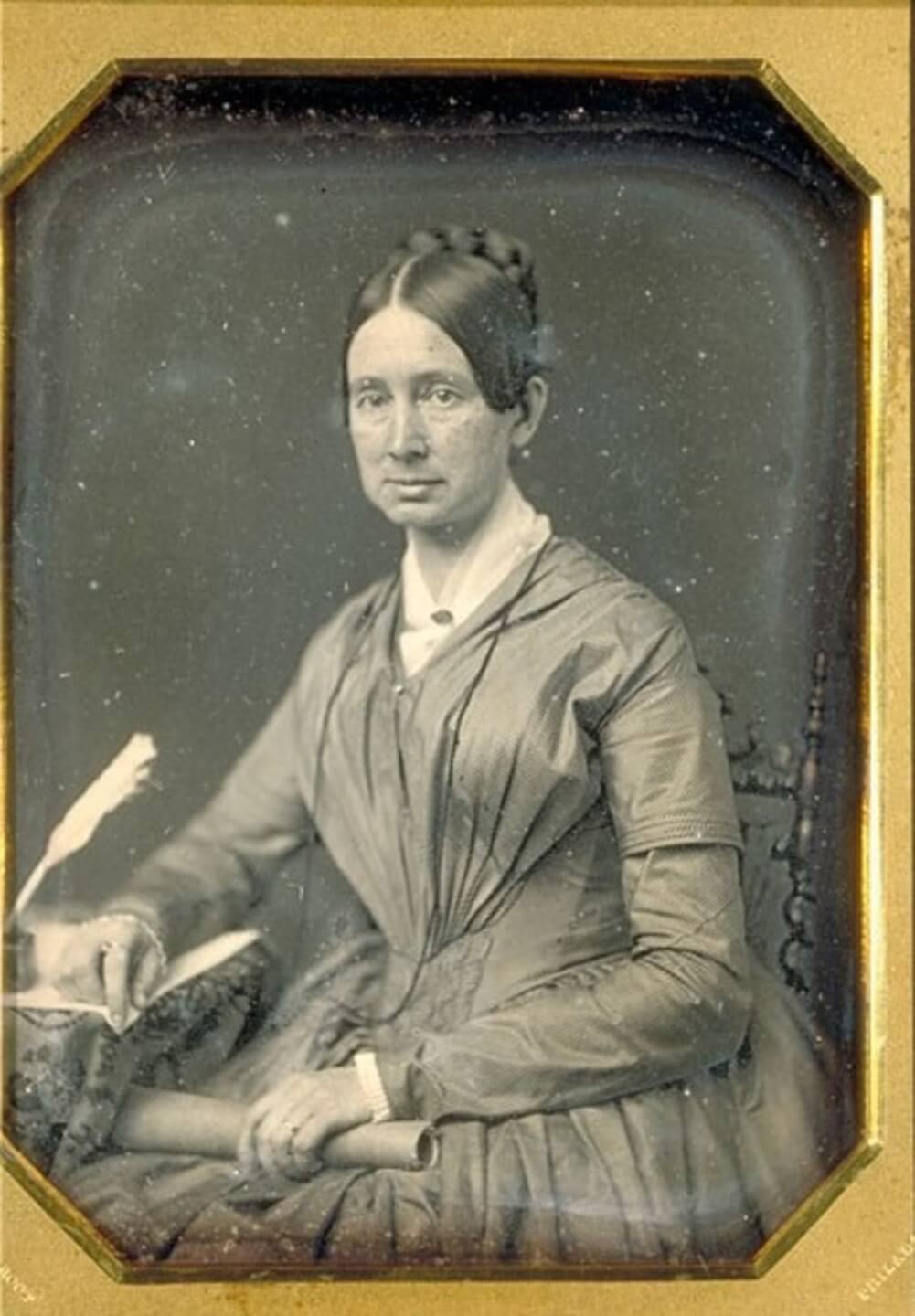
The most famous name of any dropped by Mrs. Mann in this correspondence is Dorthea Dix, who throughout the war held the position of the nation’s top caregiver as Superintendent of Army Nurses, an office created by Abraham Lincoln. Dix famously selected women over 35 of plain appearance to be Army Nurses, who she saw as less likely to be exploited by men than younger more attractive women. She also routinely dismissed those she had not trained herself, much to the consternation of Lucy Doolittle’s volunteer Sanitary Commission. Mary nonetheless recommends Lucy to Dix due to the affectionate and effective relationship Miss Dix had built with Horace Mann in the 1830s when the two were allies and leaders in the cause of proper care for the mentally ill.

Concord, January 17, 1864

My dear Lucy,

     I am not likely to forget you or any of the lovely ones whose faces loom up to me out of that dark and murky cloud which Antioch College life is to me when I look back upon it. It was illuminated then by a sun that has set, and tho’ the sun has risen elsewhere, and I expect again to rejoice in the light of it, that episode in my life I sometimes wish I could forget. But it is redeemed by many memories of individuals, and you always gratified my moral sense and my taste, so I love to be reminded of you—and to rejoice for Mr. Doolittle that such a sun has risen upon his life. I was not aware that he deserved it till I heard of the fact, and then I concluded that he must be worthy of it, although I had never known him, but I felt that you would not be likely to make a mistake, after your deep experiences in so many ways. You have been the solace of many lives—and now the soldiers are enjoying you a little while. I felicitate them upon having you for a nurse. Do you ever see Mrs. Caldwell? I have a niece, Maria Mann, at Georgetown Heights, in the Orphan Asylum lately established on the Cox estate—and I shall tell some other friends of mine that you are there, for I shall like to have them know you, Rev. Wm. Channing and Mrs. Prof. Johnson and her sister Miss Donaldson, some of the saints of the earth—and Mrs. Barker and her husband from this place. Mrs. Barker is helping Dr. Caldwell and resides in his family.

     You shall have all the books and speeches I can find for your boys—Both volumes in which they were collected are out of print, and I am just about republishing them. I do not wish any pay for them—It will be enough for you to pay the express on them—unless, indeed, I can find a way to send them to you privately. Perhaps I can through Mrs. Barker’s friends. Let them read “Thoughts for a Young Man” first, and then they will be ready for the speeches and the sermons. I should like—but I shall send you my Christian Inquirer, for it is full of gems all the time. I have long been wishing I could get it to the soldiers, but did not know to what point to send it.

     When my Memoir is published, I shall send it to you, for you will be one of those who will read all the record of that life with interest. You would not know my boys—the two eldest look like men now, tho’ they are still boys to me—They are all doing well in study and behavior, and are still in the home nest—but Horace tells me every day that if I do not move to Cambridge he must go without me—which he does not like to do—but he is in the Scientific School and finds it wearisome to go to C. every day—next fall, George enters the Sophomore class, and Benji will be following on, so I mean to go there as soon as I can. Should not you like to come to Concord to live and keep school? I will sell you my nice house and you will be a blessing to the town. Seriously, dear Lucy, you ought to keep a Kindergarten School for the benefit of so many little ones as you could gather around you.

With sincere affection, your friend

Mary Mann

     Mrs. Bottsford has lately gone into Camp Chase as a matron. I think it is near Cleveland. How many of my friends are engaged in the good work of the day, either among soldiers or freedmen. 

Dorthea Dix

Letter from Mrs. Horace Mann to Lucy S. Doolittle, enclosing letter of Introduction to Dorothea Dix

My dear Lucy,

     If you have any desire to see Miss Dix, and have not yet, you can take or send this note to her. I like to remind her of me occasionally, for she loved my husband most dearly and so did he love her. She was one of his “glorious women”.

Very affectionately yours,

Mary Mann

Mrs. Mann’s letter to Miss Dix

Concord, Jan. 18, 1864

My dear Miss Dix,

     Allow me to introduce one of our dearest and loveliest Antioch graduates, in the person of Mrs. Lucy S. Doolittle, of the Demarest Hospital. You will find her equal to any amount of devotion and self-sacrifice in the good cause. Happy are the soldiers who have her for a nurse and comforter. I do not know what you are made of. I think you will last always. I have heard that another of my friends, Mrs. Dr. Caldwell, has found favor with you. You have treasures in that household and now Mrs. Barker is added to the number, the Dr. must be very strong in his department, for her whole heart is in the work. I should think, from what I hear of you, that your nerves must have suffered from this great tension and that it would be the part of wisdom in you to drop your mantle upon some younger sister. But perhaps you do not care to live a moment after you must cease to work in this gigantic fashion. My work in a corner looks trivial by the side of yours—-but I hope to turn out three good boys worthy of their father. They are all at home, working well in their sphere, which, at present, is that of study!

     I think we are improving as a nation—which is the only consolation for this frightful war.   I have of late been reading and copying letters from my dear husband upon the causes of all this trouble—he predicted all this, but not so soon. I shall publish them before long. One of his nieces, Maria Mann, in now at the Orphan Asylum on Georgetown Heights. I consider her next to you in energy. She did a noble work in Helena, Arkansas, last year.

Yours with great regard,

Mary Mann


“Songs From the Stacks” is a regular selection from Antiochiana: the Antioch College archives by College Archivist Scott Sanders.


More Songs From the Stacks

Statement by Walter Anderson, Professor of Music – Antioch College

Statement by Walter Anderson, Professor of Music

Home » Campus News Latest » Antiochiana: Songs From the Stacks » Statement by Walter Anderson, Professor of Music

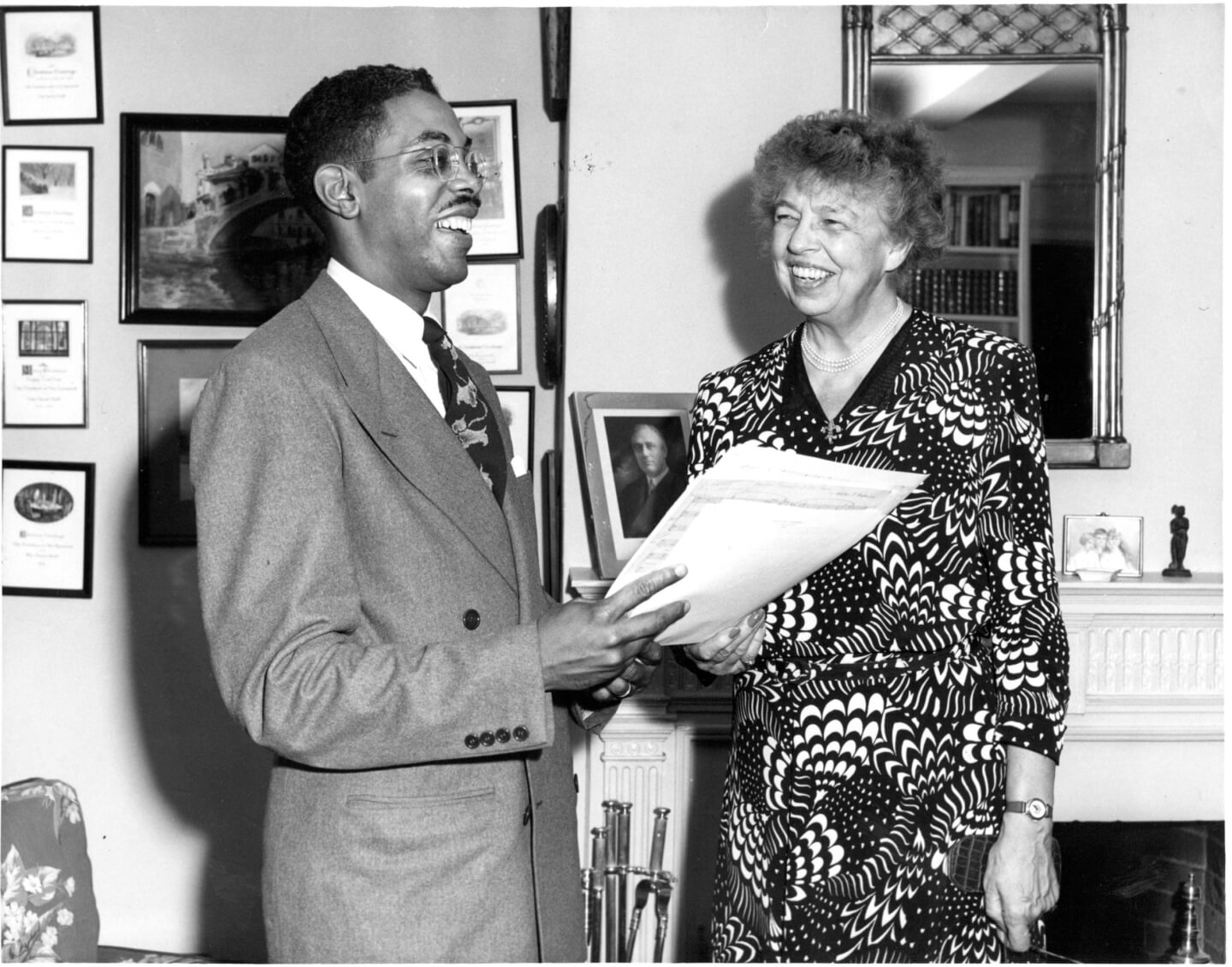
Walter Franklin Anderson (1915-2003), known affectionately as “Andy,” joined the Antioch College faculty in 1946. His appointment came with some fanfare as he was the first African American professor in its then nearly 100 year history.

A scholar of music, Anderson attended the prestigious Oberlin Conservatory where he trained on piano and organ, and also studied privately with among other notables the prolific German composer Paul Hindemith. He’d taught previously at Wilberforce, Kentucky State, and Western Reserve (which merged with the Case School in 1967), and had been for several years the Director of Music at Karamu House in Cleveland, a classic neighborhood settlement house that boasts the oldest African American theater in the United States. He was held in such high regard by the Antioch community that the Alumni Association named an annual award for advancing diversity in his honor.

Walter Anderson with Eleanor Roosevelt.

Here Anderson addresses his faculty colleagues during the second session of a 2 day meeting of the faculty in Fall 1968. Held on a Saturday morning, the only agenda item that day was the student-led Afro American Studies Institute, which sought status as a separate institution under the Antioch umbrella, something the College was already doing as it expanded into a multicampus system known as “the Network.” In 1968, one of the most traumatic years of the 20th century, advocacy of separation of the races had gained new currency in the wake of the murders of Dr. Martin Luther King, Jr. in April and Senator Robert Kennedy in June. Such ideas were not new; the physician/soldier/abolitionist/educator Martin Delany had articulated them as early as 1852 in The Condition, Elevation, Emigration, and Destiny of the Colored People of the United States, Politically Considered, but must have seemed outmoded to many who felt that too much progress in race relations had been made (especially since World War II) to turn back now. Many young people, however, didn’t see it that way in light of the violent backlash directed toward African Americans in their own experience.

The Black separatism of the late 1960s surely challenged the thinking of committed integrationists like Walter Anderson. According to the minutes of the meeting, he had written the following statement just hours before. While the document speaks to the issues at hand, more than anything it highlights his compassion and sincerity, two qualities never in question to anyone who knew Andy. To learn more about this remarkable man, pick up a copy of Playing On All The Keys, a lovingly compiled biography by Joan Hergesheimer Horn, class of 1956, available in the Antioch College Bookstore.

APPENDIX B

(Faculty Meeting of October 5, 1968) 

STATEMENT BY WALTER ANDERSON, Professor of Music

In the dark of early morn I found myself wrestling with feelings and thoughts conjured up from recollections of our meeting yesterday, along with anticipation of today’s session. I don’t believe that I have been able to express myself satisfactorily; however, in light of the trend of our discussions this morning I feel inclined to risk reading what I have put down with the hope that I possibly may be understood in what I am attempting to say.

I once was called a Caucasian. The occasion was some four or five years ago when I was having lunch in our Antioch Inn with Shanta Rao, the famous dancer from South India. She revealed certain observations which she had made during her visit to the United States. For one thing, she felt that her native style of dancing was much more limpid and more graceful than Western ballet. She said, “Just look at all those big, chunky muscles your women dancers develop in their legs.” But instead I looked at hers and quickly recognized that she had a point. She went on to explain that extensive massaging, which was a regular part of her routine, accounted for the supple and restrained appearance of her whole body. Now I imagined this massaging as being one of the more comfortable parts of that routine until she explained that it was accomplished by having a two-hundred-pound man walk over her for four hours every day. Then, as she lit into her vegetables and fruit while I finished my hamburger, she said, “You know, we Indians aren’t the meat eaters that you Caucasians are,” whereon I replied, “You’re right; we Caucasians are quite cannibalistic.”

I think this incident serves to illustrate how under even the most congenial circumstances we may not altogether hear one another in conversation. If I observed anything at all last year, as in Geneva, Switzerland, I read the Antioch Record some five or six weeks after it was issued, nobody back home at Antioch seemed to be listening to anybody else. Especially did this seem to be true with regard to the all-encompassing concerns being expressed on the Vietnam War, the quest for greater participation of students in the decisions of the institution, and the current racial revolution.

As an integrationist, I first reacted, as a matter of private reflection on the demands of the Black Students Forum for the establishment of a black inner college, with shock and even with dismay as I perceived its threat to my position and my efforts at Antioch for some twenty-two years. I thought to myself, “We almost had it made, and now we resort to our own form of apartheid.” But on further reflection, and this I take to be much more significant, I recognized that apartheid as imposed by the established order, as in South Africa, for example, is a very different institution from the honest quest for identity and self-respect on the part of an individual or a group of similarly concerned individuals in the matter of the recognition of their cultural heritage both for themselves and for others. And so I have come to a position in which I would vigorously support the opportunity sought by the Forum. Essentially we are confronted by the phenomenon of a large, vocal, active group asserting the right for individual considerations, which, except for the social revolution at hand, more likely would have come to our attention on an individual basis. Concomitantly, the faculty and administration are placed in the rather unusual position of having to legislate on certain aspects of a revolution when normally revolutions cannot be legislated.

However what I have to state here in the matter of approval of a single project would stand for nought except as indeed I clarify my wider views on the racial problem of our country and the responsibility I feel any institution of higher education should assume as an essential, worthy goal in the present time. This significantly is related to method.

The Antioch which vibrated for me was motivated essentially by an authority which resulted more from individual concern in action than from talk. The miracle of the institution, as I knew it at its best, could be seen in a variety of positions aimed toward a common goal. Our mores—those tacit, voluntary agreements by which we lived—were supported by a wonderful mix of ethical views, both atheist and theistic, which to a large extent were communicated and identified through strong individual faculty participation in the community. We seemed to extract our community processes more directly from our experiences than from endless, prior verbalizing, which at the present time, in my opinion, has yielded a constellation of successive hang-ups.

With respect to our racial problem, I think that we would have a more immediate and greater yield of positive results if a variety of programs concerned with racial justice were under way. I suppose that few, if any, of us would complain if we could experience the positive results of different programs which had been permitted to develop in their separate ways. I have some concerns, on which I do not pretend to have great wisdom, with reference to two questions which I shall indicate without comment: (1) I wonder a bit about education which for some may proceed in alienation from the larger community both within and outside the institution. (2) I wonder at the possible paralytic effect which might result if the response on the part of the major community is induced from a posture of guilt or fear.

As an integrationist, I personally want to serve the needs of the separatists because at least they have had the guts to get their program going. (Here I have a semantic problem; for every time I say they, I also want to say we. Put together, the words become thwee, which sounds as though I can’t speak plainly. But the combination of them and us comes out better for the word, thus, clearly implies action following reasoned consideration.)

I should like to see quality established as rapidly as possible, not at the lower, but at the upper levels. But given ten men, of whom one is without legs. I do not believe that anything is being equalized if the legs of the other nine are cut off. Accordingly, I don’t identify with violence or threats. For example, I’d have much preferred being confronted by demands from the Black Students Forum which read, “We believe, and are convinced, that this institution will function better if our demands are met” rather than to threaten that “these demands must be met or this institution will not function.”

We face difficult times and difficult tasks. The problem at present appears to be more emotional than educational. Ultimately what we do now may prove to be eminently more important than anything we say or any name by which we may be addressed. There is a question in my mind concerning whether excesses undertaken in the effort to establish a new morality may in themselves create a new immorality. I think that all of us might undergird our well-intentioned feelings with the value understood in the realization that corruption need not be dealt with corruptly.

I was taught love, and my religion expects love of me. Moreover my life experiences confirm for me that through love, patience and hard, intelligent effort we can win as a total body of human beings.


“Songs From the Stacks” is a regular selection from Antiochiana: the Antioch College archives by College Archivist Scott Sanders.


More Songs From the Stacks

This site is not affiliated with Antioch College, Antioch University, or the Antioch College Alumni Association. It is provided as a service to the Antioch College community to provide resources to inform people about the current situation at the college and what can be done to save the college before it's too late.