
Among 19th century Antiochians, teacher, artist, poet Irene Hardy (1841-1922), class of 1885, lived one of the more well-documented lives due to the memoir she began in retirement, “The Making of a Schoolmistress.” After her death, her 530-page manuscript ended up in the hands of her brother Lewis, an Antiochian of the 1870s, who resided in Yellow Springs, and he gave it to Antiochiana, where it was eventually discovered by longtime Antioch Professor of American Civilization Louis Filler. He edited the work and published it in 1980 under the title “An Ohio Schoolmistress,” leaving out only the instances where she repeated herself and “Miss Hardy’s practice of footnoting the Latin name of just about every flower and tree she mentions in the text.” On her extraordinary powers of recall, Filler wrote in his introduction that “Irene Hardy’s mind was an all but fabulous repository of memories of the world in which she lived.”
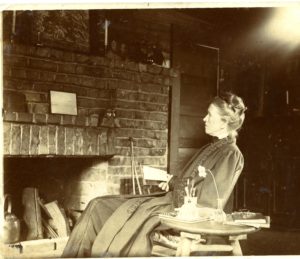
Irene Hardy, 1908.
Hardy wrote the following letter to Arthur Morgan, then the fairly new president of the College, at a time when he was about to launch his
“New Antioch” based on alternating work and study, which of course we call Cooperative Education. Part of that launch was a mass mailing to former students about the exciting changes to come to their school, and it seems he also asked if she would serve as a representative of her graduating class, which on paper was 1885. After sharing the fears she had about his transformation of Antioch College (her comment on “omitting the things which pertain to the moral and spiritual ideals now so much needed in the world” rings frighteningly familiar in the 21st century landscape of higher education), she explains why she isn’t really a member of the Class of 1885 at all.
None of the hopes she shares for the College had been realized by the time of her letter, though before it was finished, the Morgan administration would expand the library, build a separate gymnasium “west of the quadrangle” just as she envisioned it, and “a building otherwheres constructed for chemical and other laboratories” we called Science. Morgan would also construct a new place for worship called Rockford Chapel. The chapel she so cherished would never again serve “the religious life of the College” as she put it, but remained central to campus life as Kelly Hall until Main Building was closed down in 2008.
No. 453 Melville Avenue,
Palo Alto, California.
July 19th 1921.
My dear Mr. Morgan:
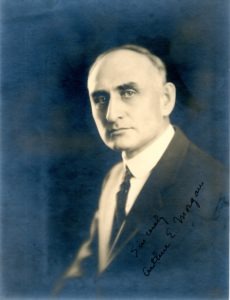
Antioch College President Arthur Morgan in 1921.
I thank you for the opportunity given by your letter of July 2nd to express my feeling of gratification at the prospects of Antioch College.
I was somewhat disturbed in mind at the first news relating to what seemed to me a radical change in the ideals of the first President and the founders of the College; but later bulletins and other information have removed my fears concerning that point.
It seemed to me that if the College were to be turned into a trade school for the purpose of furthering material progress mainly, omitting the things which pertain to the moral and spiritual ideals now so much needed in the world, it would wholly destroy the purposes of the founders. I see, however, now, that these things are to be not only kept alive but restored to their original force.
I am very sorry that I am unable to undertake the Chairmanship of the Class of 1885 with which I took my degree. I am not personally acquainted with a single member of the Class; I never saw or met any of them for reasons which you will understand with some explanations
I entered Antioch College in September, 1861, as partial freshman. My preparatory school had given me no Latin, no Greek, and no ancient history. I had, therefore, to do three years’ work in these subjects, which I did in two years. At the end of that time, owing to conditions brought about by the War, the College classes were suspended for one year and the faculty gave all their time to the preparatory school.
I went home, to teach. To shorten my story,- I was in and out of the College a number of times to teach, until 1867, when I was nearly ready to take my degree. Although I was matron of North Hall and teacher in the preparatory school from 1874 to 1876, I did not care to take my degree, notwithstanding I had done work enough to entitle me to it; nor was I ever afterward a student there. In 1871 I came to California, and on a return visit In 1883-4, when Dr. Daniel Long was President, he urged me to take my degree at the next Commencement. I could not return to do so, but the degree was granted in 1885 – eighteen years after It was mainly earned. You will see by this somewhat tedious story that I could not possibly act as Chairman of the Class.
Other reasons are,- that I am approaching my eightieth birthday, and that I was deprived of my sight more than ten years ago.
I am not in a position financially to do much, though my inclinations would lead me to carry out my many dreams for endowing the College liberally.
And here I venture to speak of some of the things I had hoped for and imagined; also, some of the things done in the past few years which were a source of grief to me and to a few others of my time and a little later:
My hopes were that the College might be endowed and made able to continue work Iike that done by Horace Mann, Thomas Hill. Austin Craig, and other later successors. In imagination I saw the beloved old chapel adorned with portraits of Presidents Mann, Hill, Craig, Weston, Orton, Hosmer, and other great teachers like Suliot and Claypole.
I hoped, too, to see the small library enlarged to liberal proportions; to see the College acquiring the Glen property for the study of forestry and other sciences; to see a gymnasium built on the west side of the quadrangle, and a building otherwheres constructed for chemical and other laboratories. So then it was a real grief to me when I heard that the chapel, sacred to the religious life of the College and peopled by memories of the great teachers, had been made into a gymnasium and renamed, Kelly Hall. I wonder if I can hope that this may be remedied some day.
Nearly twenty years in teaching English Literature in the Oakland High School and Stanford University and the great enjoyment of that work make me wish that I might be of use to you in advising with the head of your English Department on the subject of courses,- especially in the literature and history of America. I hope that the there will be expanded courses of reading in these subjects both in the preparatory school and in the College, and that whoever the teachers are they will be men end women of great enthusiasm and liberal spiritual endowment.
I wish I might be able to tell you and others who are to administer College affairs of some of the customs and traditions of the old time, not a few of which would be worth reviving and keeping alive.
With cordial wishes for the success of your plans for the College, I am
Very sincerely yours,
Irene Hardy
“Songs From the Stacks” is a regular selection from Antiochiana: the Antioch College archives by College Archivist Scott Sanders.
 years later, with the statue a month from its dedication on the Fourth of July, his widow Mary wrote the following letter to Senator Charles Sumner. A gigantic figure of his time, Sumner was a leading member of the political faction known as the Radical Republicans, who made certain that the goal of the US Civil War was the destruction of slavery, pushed hard to ensure that the Fourteenth Amendment passed, started impeachment proceedings against President Andrew Johnson, and enforced the most punitive Reconstruction policies that they could upon the former Confederacy.