Holiday Greetings – Antioch College

Holiday Greetings

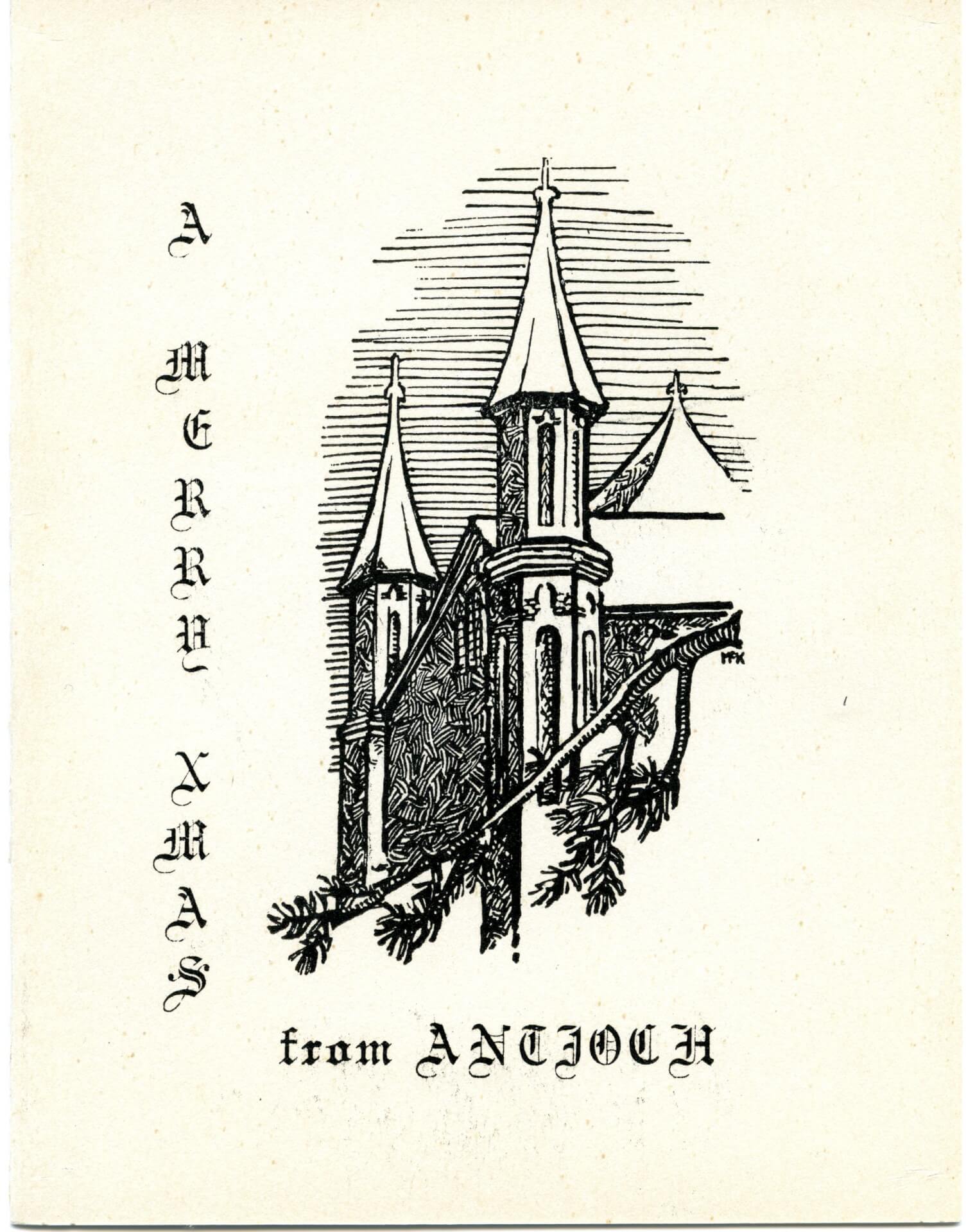
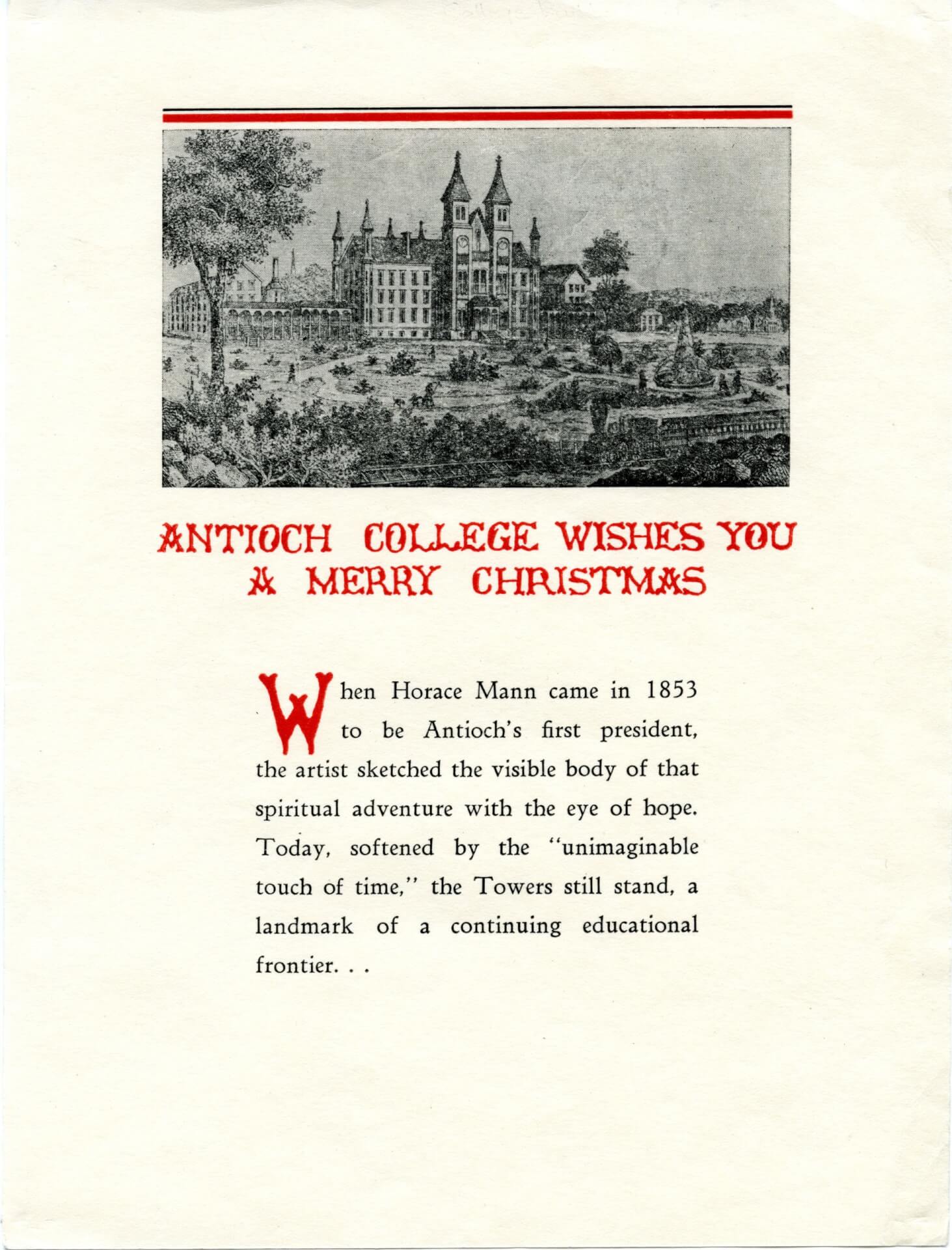
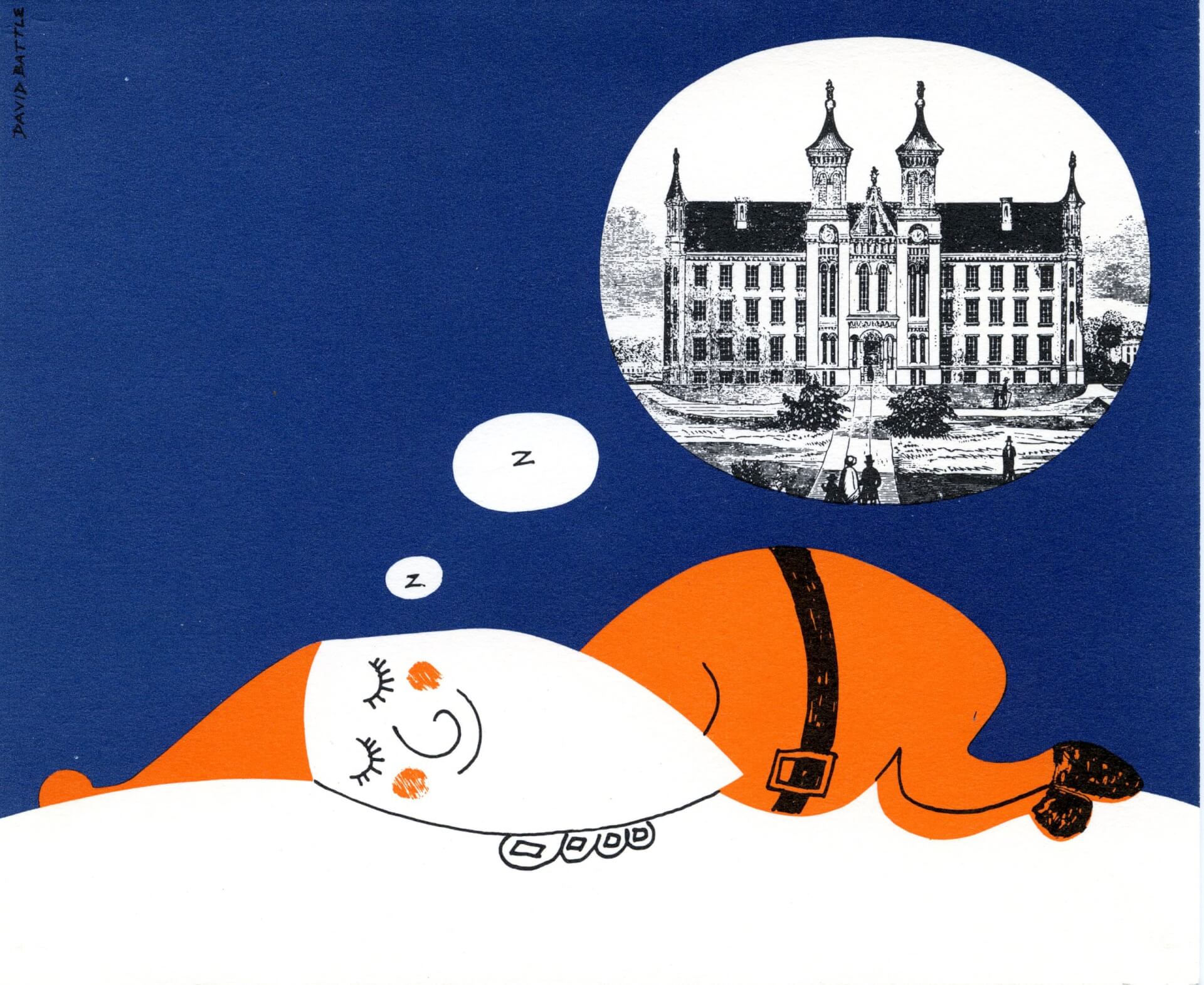
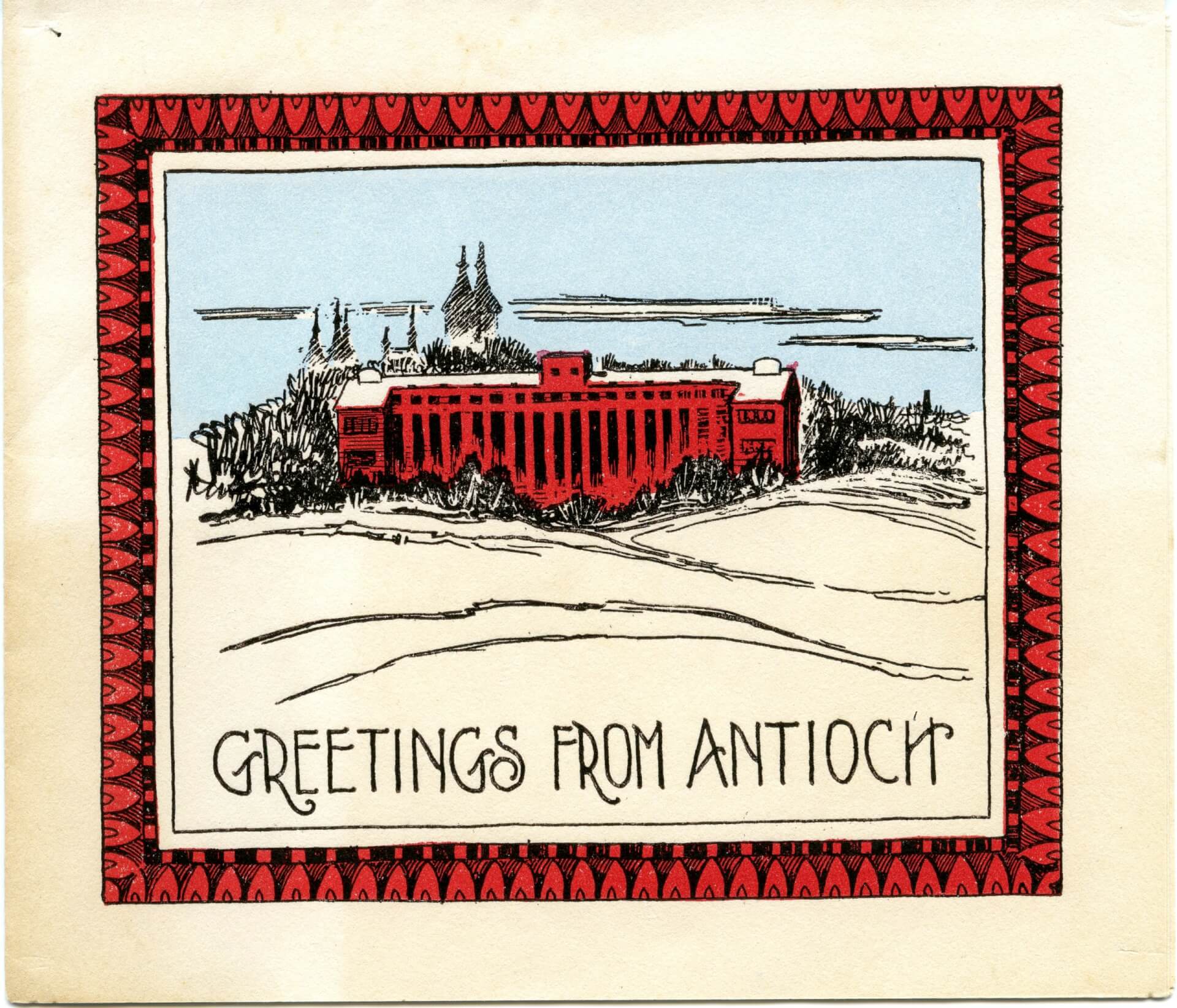
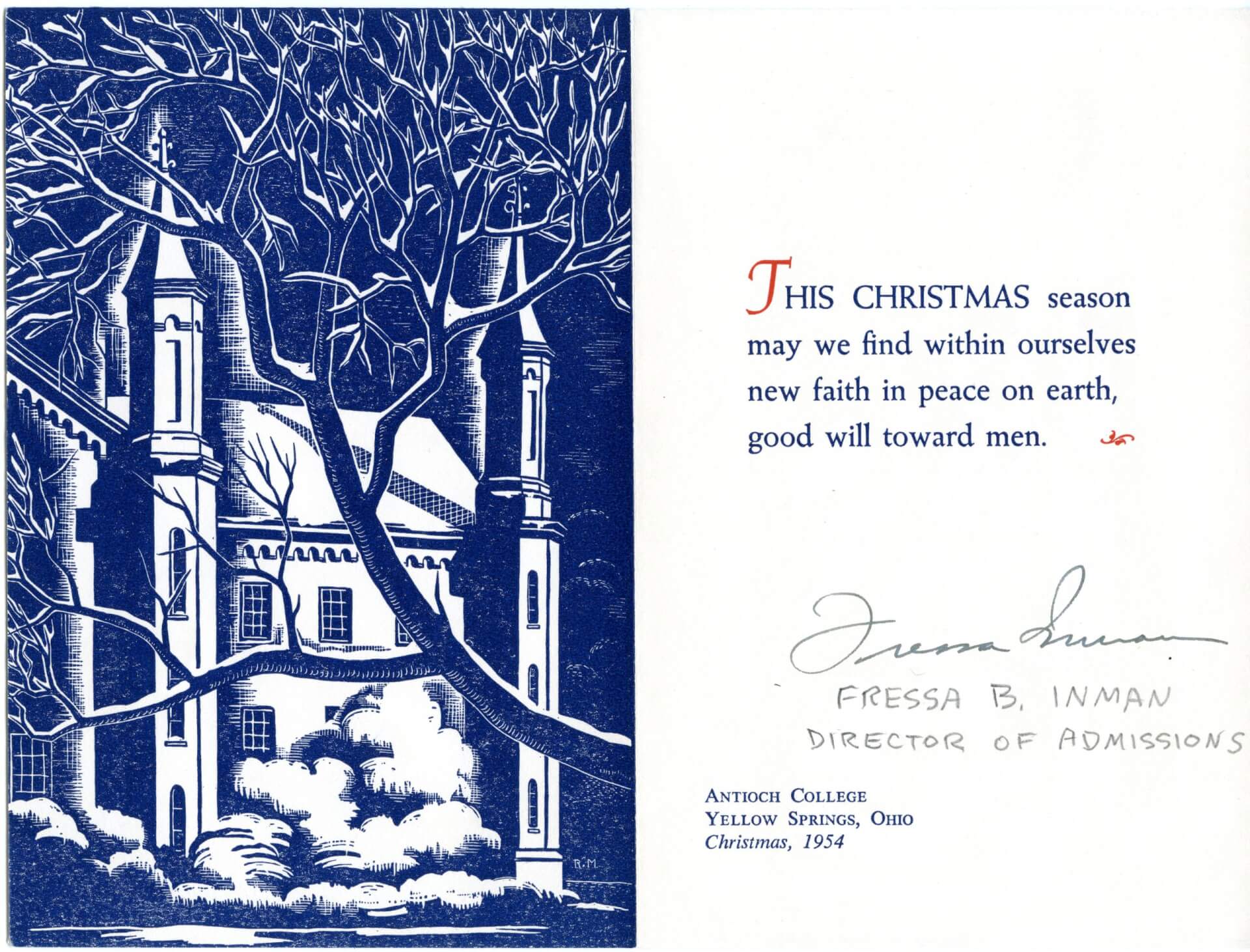
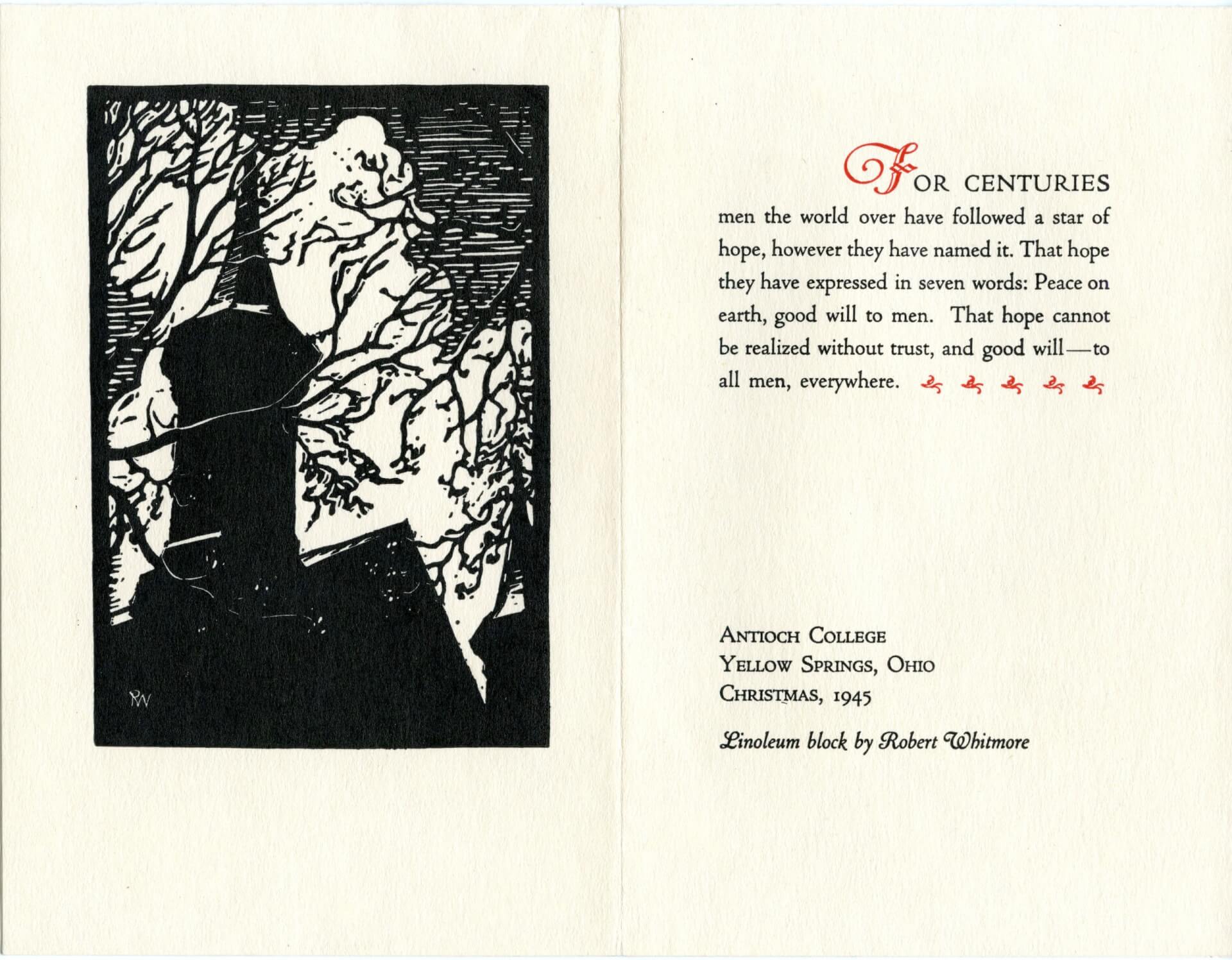
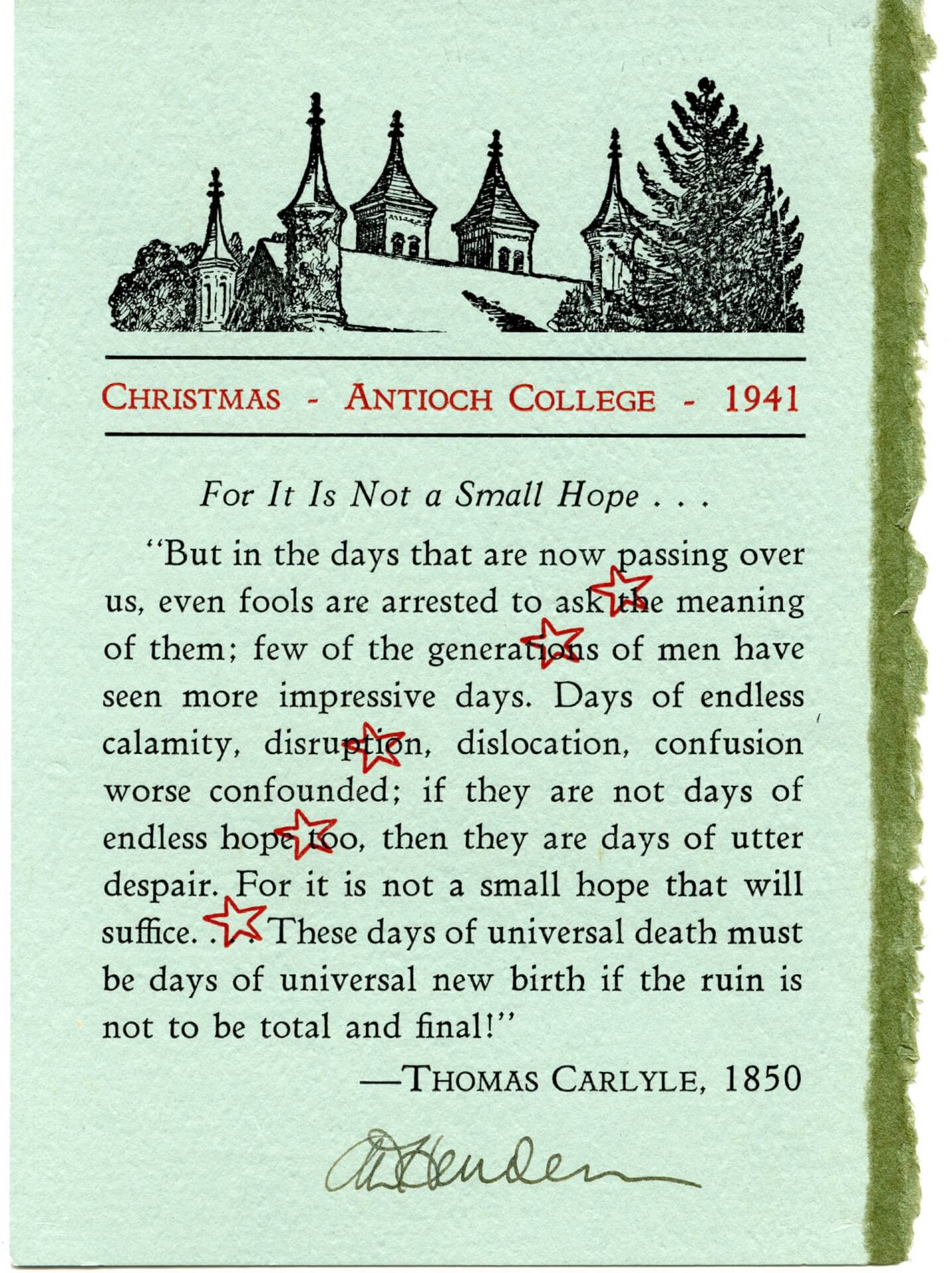
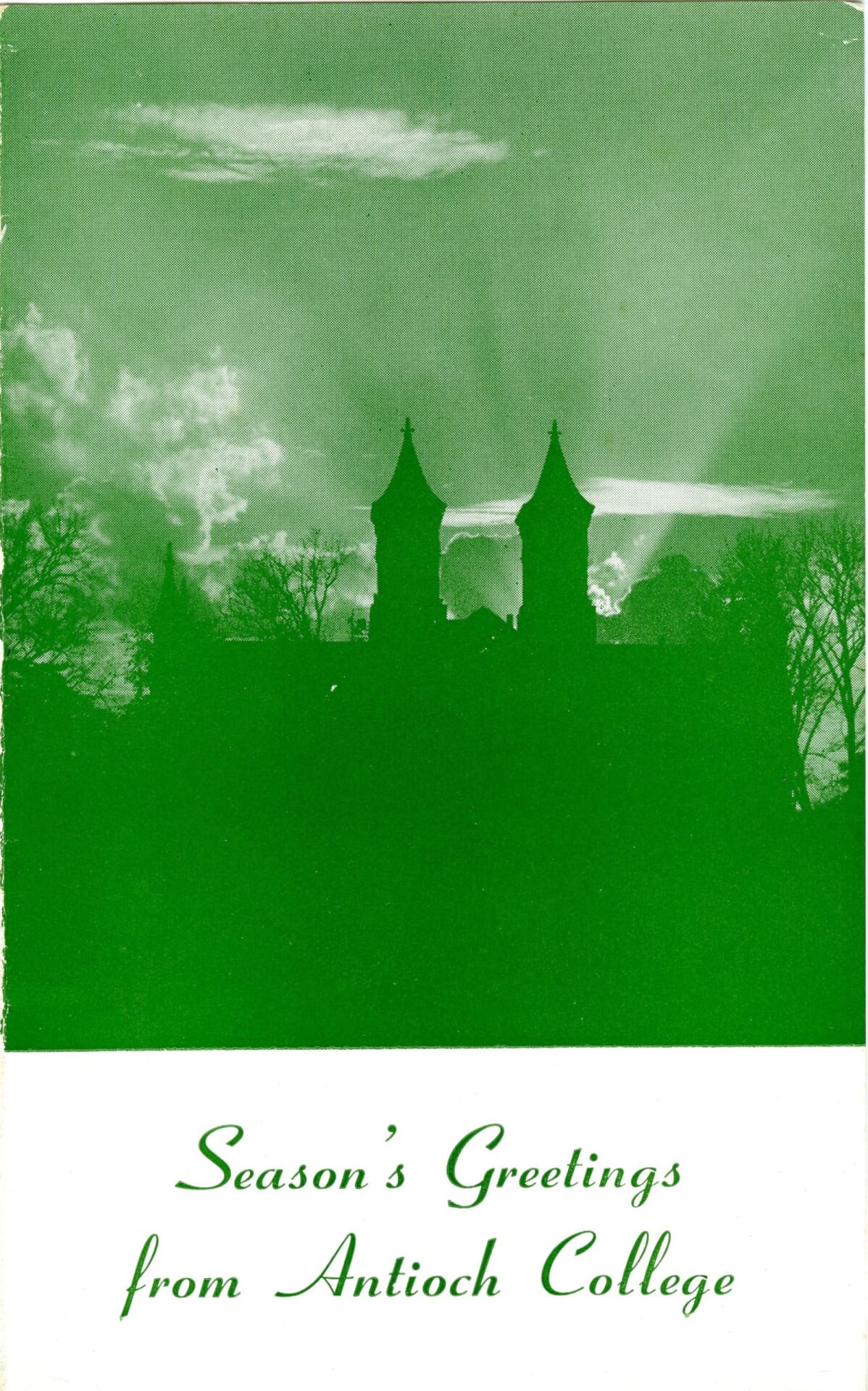
With so much to do and so little time, Stacks makes it easy this time around: no transcriptions of inscrutable 19th-century documents, no explanations of who is who, no understanding to convey, no context to understand, and certainly no wisdom to impart. Just a selection from Antiochiana’s file of Antioch greeting cards from holidays past. 

Click to enlarge and scroll through the images


“Songs From the Stacks” is a regular selection from Antiochiana: the Antioch College archives by College Archivist Scott Sanders.


More Songs From the Stacks

Mary Mann to Horace Mann Jr 9 Nov 1864 – Antioch College

Mary Mann to Horace Mann Jr 9 Nov 1864

Home » Campus News Latest » Antiochiana: Songs From the Stacks » Mary Mann to Horace Mann Jr 9 Nov 1864

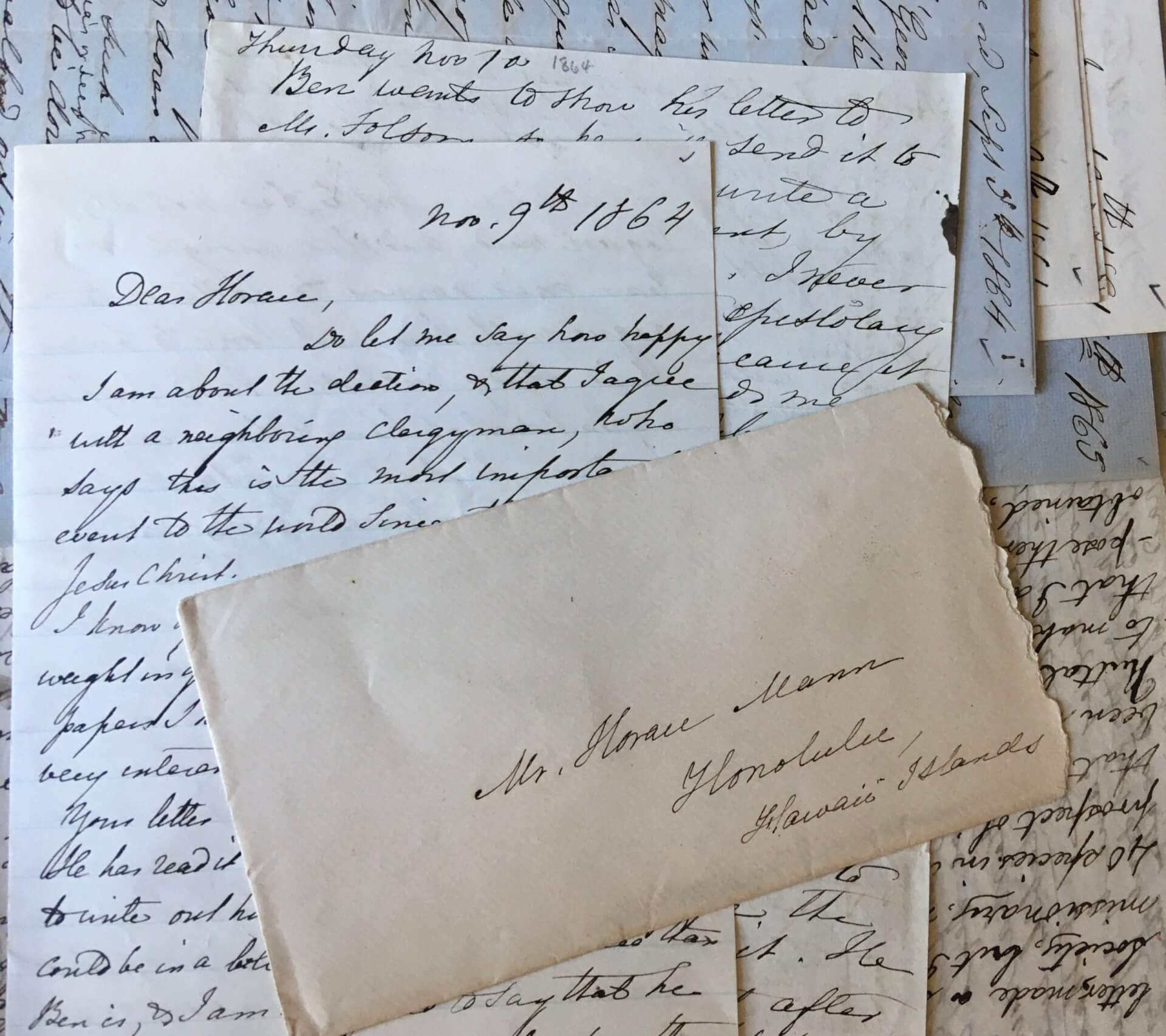
In a well-timed coda of letters to Horace Mann Jr. in Hawaii, his mother Mary Mann opens with a thought shared then and now by millions and millions of people around the world: the monumental importance ascribed to the outcome of an American presidential election. In 1864 and 2020 both, the “soul of the nation” was at stake as president-elect Joseph R. Biden, Jr. put it during his campaign. Had the Democrats won in Mary’s time, the US Civil War might have ended without victory and with chattel slavery largely intact in the states where it still existed. Had the Republicans won last week…well, let’s not go there.

For obvious reasons, it’s been an exhausting week at the end of an exhausting term, so please forgive me for not saying much else about her letter (not to mention the abrupt change to first person voice). The “Sailor’s Fair” Mary mentions was a fundraising event for the United States Navy. The general helpful to the cause of cousin Maria Mann’s school, Ethan Hitchcock, had been a military advisor to President Lincoln and headed up the agency in charge of prisoners of war. “Mr. Folsom” might be Charles, a Harvard librarian, and he might not (the Manns knew lots of Folsoms). “Ellen F.” also a Folsom, was perhaps Horace Mann Jr.’s closest friend. 

Nov. 9th 1864

Dear Horace,

     Do let me say how happy I am about the election, & that I agree with a neighboring clergyman, who says that it is the most important event to the world since the advent of Jesus Christ.

     I know of no other books ‘worth their weight in gold.’ These cost 9 dollars. The papers I have stuffed in contain some very interesting speeches.

     Your letter to Ben was most opportune. He has read it over & over again, & begun to write out his travels for you. Nobody could be in a better state of conscience than Ben is, & I am delighted to say that hs thinks more of what you & G. say than of what any one else says — for I shall like to think that you will always have influence over him, and you will have if you can bear with his crudities — but he has not a logical mind, and it is enough to tear one’s nerves to tatters to argue with him. I long to have him study Euclid — and I expect a great deal of him when more mature, but it is a psychological phenomenon to me to see the difference there is between him & you two boys in that respect. He can see that two and two make four, mathematically, which some people cannot, but he does not apply the proposition to morals — but is always in puzzles about how things ought to be — & so afraid of not being independent in thought that he loses the advantage of other people’s thoughts. It is the occupation of my days & I may almost say of my nights to think of the right thing to say to him about this & that, and to keep him from suffering too much from his want of insight into relations between people and between things. But he is so desirous of doing every thing right that I am encouraged to think he will see into things and their relations more to his satisfaction bye & bye. I don’t want him to go to college till his ideas are more settled, because I want him to enjoy & not contend with his companions (I do not mean fight, but dispute). George has such pleasant relations with every body that I hope he will get it by magnetism, as it were, since he admires G. so much. Your views about what he should do he has great respect for, & thinks your method of doing every thing the very best. There is no other influence I value so much. He looks quite handsome since he has grown so tall (6 feet 5 inches) and more & more like papa’s figure, so that everyone remarks it. I have been looking over manuscripts from which papa published, to find autograph sentences for the Sailor’s Fair — for a good autograph sentence will sell for a dollar — and find a great many little scrap books containing sentences (I do not give any thing away that has not been published) and Ben is greatly interested in every word. You want to know what I am thinking about — and now you know.

     I believe I told you Cousin Maria has had some difficulties in her orphan school in Georgetown. They have resulted in setting her & the school on a firmer foundation than ever. Gen. Hitchcock & Charles W. Dana have taken up the matter quite warmly, as well as many other good people. All good things will go well now, I think — it is a new era in the world. I hope gold will go down while other good things go up. I hope to be able to get my book published now. B. sends you a sheet of his travels, I shall exhort him to write the rest more legibly. Good night.

your loving mother
Mary Mann

(The following enclosed with the above)

Thursday Nov 10

Ben wants to show his letter to Mr. Folsom, so he will send it to you by mail. He will write a great deal better account, by writing it to a person. I never can help thinking the epistolary form is the easiest, because it is so to me. This reminds me of a book called the Schönberg Cotter Family which I want you to read some time. Perhaps some one will have it there, and now you are among the literary people you will be able to get books. I do not add to the weight of this package because it costs so much. George has just arrived to attend a dance & invited Frank Stearnes to come with him. G. still loves to dance enough to take the trouble to come up for it. He is off again down street after some lady to go with him, I suppose. I want you fully to understand one view I have of your absence. It has worked beneficently just in the way I expected. It is good for people to hold each other at arm’s length sometimes, to see each other in perspective, as it were, where petty differences do not warp the judgment, and real qualities appear in their true proportions. I have seen & felt the good of it myself, and I was sure it would work well for Ben. It is well for him to be here alone with me for a while, long enough to “orient himself” without feeling himself compared by others. He compares himself with you & G. which is a useful way to look at himself, but it needs quiet & absence of excitement to be able to do this. He is very much influenced by the way people feel toward him — he does not wish to be flattered, but he enjoys being appreciated. He is of a temperament which makes this of real consequence to him. I can say a thousand things to him now which I never could before without fretting him or hurting his feelings. Your spiritual presence is of immense value. He has laid aside his pranky ways & enjoys being thought a young gentleman instead of a boy. His simplicity always interests me, tho it sometimes makes him appear childish. He is just at the age when ideas are being potent. I am never tired of watching youthful struggles & experiments.

Where I see principle working I always know things will come out right— but I sympathize very much with the strivings. He is going to the first party where he has appeared in this new character. Ellen F. is going with him so I hope he will enjoy it.

Mother


“Songs From the Stacks” is a regular selection from Antiochiana: the Antioch College archives by College Archivist Scott Sanders.


More Songs From the Stacks

BP Mann to Horace Mann Jr 7 Nov 1864 – Antioch College

BP Mann to Horace Mann Jr 7 Nov 1864

Home » Campus News Latest » Antiochiana: Songs From the Stacks » BP Mann to Horace Mann Jr 7 Nov 1864

After receiving a pair of haranguing entreaties from his mother Mary and his brother George to pack up his expedition to Hawaii and come home to Boston, Horace Mann Jr. received the following account of his youngest brother Benjamin’s trip up the Labrador coast. Born in 1848, Benji clearly shared his brother’s scientific bent (especially his interest in biology), and would go on to a career in entomology with the USDA. A founding member of the Cambridge Entomological Club (est. 1874) and editor of its journal Psyche (still in print today), he was also a bibliographer by nature, a talent reflected in the way Antiochiana’s Benjamin Pickman Mann collection is organized.

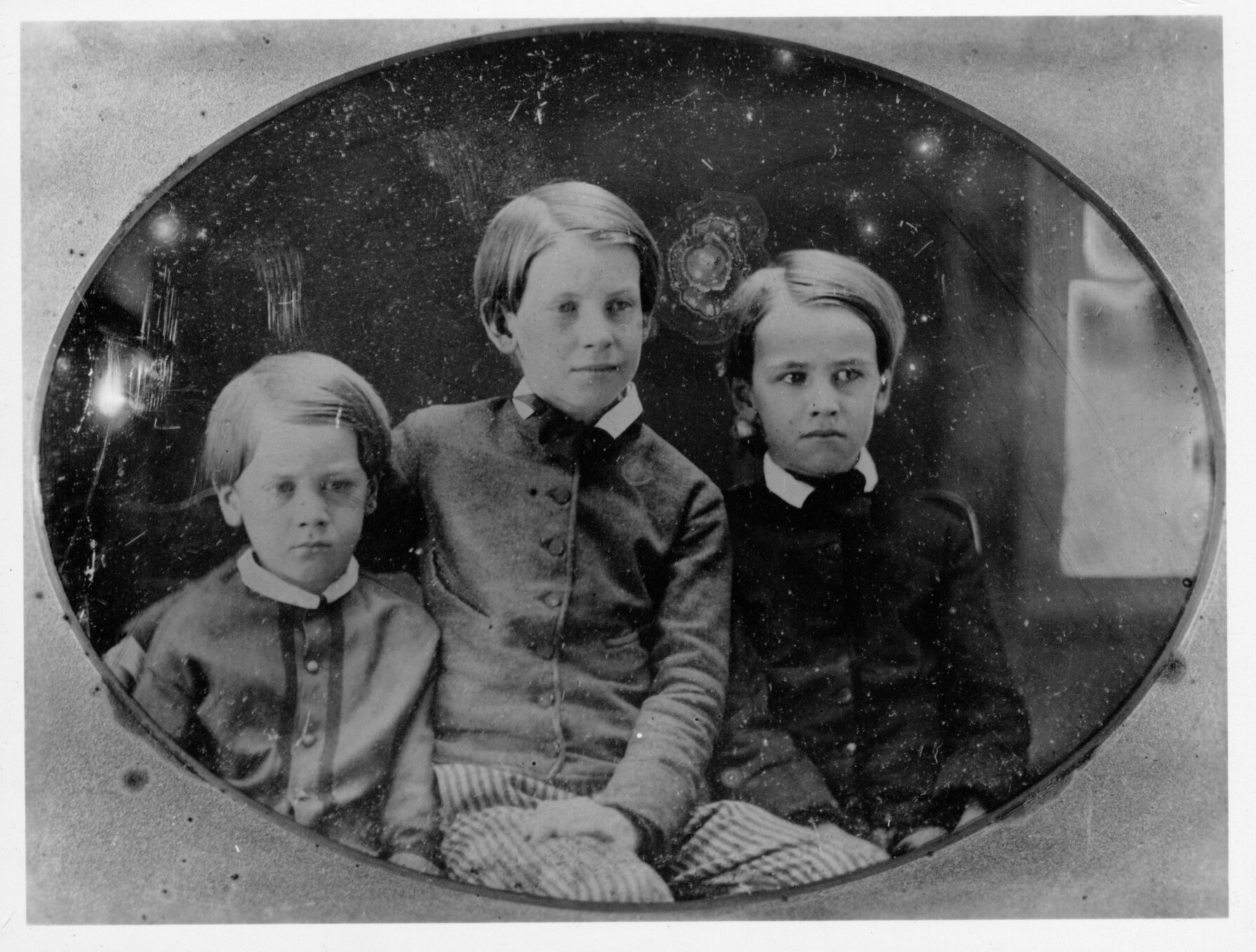
A black and white photograph. The sons of Horace and Mary Mann, c1855. Left to Right, Benjamin Pickman Mann, Horace Mann Jr., George Combe Mann.

The sons of Horace and Mary Mann, c1855. Left to Right: Benjamin Pickman Mann, Horace Mann Jr., George Combe Mann.

Eager to get to the copious details of his journey, Benji brushes Lincoln’s imminent reelection aside, unlike the letters by Mary and George. He’s so excited to tell Horace Jr. of his travels, in fact, he relates them in one massive paragraph of over 2000 words, broken only by a few hand drawn diagrams (omitted here for layout purposes but noted in brackets). Though he cannot know it, Benji dramatically illustrates to 21st-century eyes how much science has changed since his time.

He’s sailed to the Canadian provinces of Labrador and Newfoundland on an Oological expedition to collect birds eggs. Then a legitimate science, but now long-since outlawed, without the benefit of modern binoculars, oologists found it extremely difficult to study birds in the wild and resorted to taking their eggs for study. His account of “egging” for auks or alcids (such as the murre and the puffin) unknowingly explain how the largest of the species, Pinguinus impennis, known as the Great Auk, could be hunted to extinction by the mid 1840s. He later collects bones from an Inuit grave, again for scientific purposes, dismissing the objections of local fishermen (presumably Inuit themselves) as superstition.

Found amid the meticulous descriptions of his surroundings are Benji’s encounters with the local population, the colonialism of the time on full display. For example, he meets a missionary (undoubtedly there to convert Inuit to Christianity) and characterizes the “Esquimaux” as under the man’s care. The Acadians he speaks of that “talk a corrupted French” are a unique culture, descendants of 17th-century French settlers and indigenous populations, and the “adverse conditions” that drove them from homes in Nova Scotia occurred during the British conquest of Canada in the French and Indian War and The Great Expulsion that came with it.

Concord, Mass., U.S.A., Nov. 7, 1864

Dear Horace

     There is no doubt regarding the elections tomorrow. Hon. Mr. Whiting gave us a speech in the Town Hall on Saturday night, and it is said that he converted many to Lincolnism. I know for my part that he converted Dennis O’Keefe, who is still perseveringly going to school. I got your letter of Sept. 8 on Saturday (5) of this month, and so I am going to try to do what you wanted. I was very glad to hear the advice you put in, and read the letter over many times. There was a dance in the Town Hall Saturday p.m., which I attended. The first harbor we touched on in Labrador was Sloop Harbor, among the Goose (?) Islands. On going ashore, we ran into a snowbank of some hundreds of feet in extent, but not very deep. The island was perhaps 200 feet high, the slopes being rather gradual, and on the top was a small lake, such as we sometimes find in our meadows where turf has been dug out. The island was pretty large, and on the further side of it was a settlement of people who formerly came from Canada, but have lived here a long time. These talk a corrupted French, and are people who were once in good circumstances, but were driven from home by adverse circumstances. The island is rocky, something like the summit of the “Cliffs” at home, with slumpy moss, and many crawling birch (?) trees. There are about a hundred islands, some more rocky, some entirely rocks, not all as high as this. There are a few cliffs, and some places on the islands appear as richly soiled as some of our meadows at home. The Eider Ducks breed on the islands in proportion to the pond-area they contain, I having collected 70 or 80 eggs in a place of 20 feet by 10 under bushes of two feet high, and near a pond. I might have got bushels of Eider Down, which would have sold, if I pleased to dispose of it thus, for a large amount, but I had all my room filled with eggs, as heavy a bundle as I could carry, and had to throw all my down away! The Gulls breed on the side of steep hills, on a ledge, or sometimes make a round and shallow nest on a level piece, at the foot of a hill or terrace. The Cormorants breed on the ledges of high overhanging cliffs, where a man must be lowered to obtain them. Mr. Bradford got about 40 eggs, but no more, as he was afraid the man would fall! How he could fall at all remains in doubt to me. The Auks breed in vast numbers on high rocky islands, in crevices under the rocks as far as they can squeeze in stern first, and leave the eggs to sit on themselves. The Murres do not breed on these islands much, if any, but on Treble(?) Island, which we touched after leaving here, and on Murre Rocks wh. we passed before arriving here, and on Tinker Island, to be mentioned hereafter, and on various other detached islands, the Murre is the order of the day. Again on low islands, with easy ground, the Ruffins burrow a perfect network, so that you can walk nowhere without slumping. We remained in this harbor 5 days, occasionally seeing whales of different kinds, amongst others one white whale. The whole S.E. part of Labrador is far north on the coast as L’Ance a Loup belongs to Canada, beyond this as far as Cape Harrison to Newfoundland, and the Moravian missionaries appear to have the rest of the eastern coast. But more of these as I arrive at them.  Treble Island, where we stood off and on for a while, and went ashore, is a high island of solid rock till you arrive on the tip top, but it is very rough, all piled in every imaginable form leaving cracks and crevices everywhere, which the Murres fill with eggs. The eggers going into these islands break all the eggs they find, and next day a supply of fresh eggs is laid. They take these, and kill all the birds they can hit with their sticks, and they sometimes get a great many. From here we progressed till we arrived at Salmon Bay. Here is a missionary who preaches weekly to the fishermen for 5 or 10 miles along the coast. There is a building there where the missionary, his wife and child live, and in which ia the chapel, a room about 1/2 the size of our Unitarian Vestry, low, but useful for the purpose.  The vestry at Wayland forcibly reminded me of it. This island (Caribou) is a low island with hills of 70 or 80 feet on each end, and marshy in some places; but in winter the missionary and his Esquimaux, for I believe he has a few under his care, remove up Salmon River about 9 miles to Winter Habitations.  The missionary is a very pleasant man, an American, employed by a British society, C.C. Carpenter by name.  We stayed here over Sunday, and our Episcopal minister, we had Mr. Wesson also, preached, but I did not consider it worth attending, although afterwards I found that he preached pretty well.  On the 21st of June, the day after we left Salmon Bay, we ran into the ice lumps, small pieces of ice, none or few of which exceeded 20 feet in length. We spent a part of our day amongst these, but a high wind came up in the night, and on awaking the next morning, we found ourselves in Belles Amours Harbor. This harbor was nothing more than a bight, or piece of water running inland around a curve, thus, with a little island in the middle, covered at high tide. Here the hills were 300 or 400 feet high, and some cliffs of about the same height, but not extending all round the harbor. There is a large lake in the interior, from which a river equal to our streams of size runs into the sea. Here I obtained among the thickets the first Black Foil warbler I had ever seen, and came to appreciate in modo if not in re what pine forests were on the White Mountains. We remained in this harbor four days, and I got the head of a grampus, which was lying around loose, and which I intended to bring home for the Museum; but either by accident or design it got overboard about a week after. On the 26th of June we entered Henley Harbor in Chateau Bay, which I shall describe from a composition I have written on the subject. This harbor is in the Straits of Belle Isle, near Cape Charles, and is composed of three islands placed somewhat thus: [illustration] As I am not a very good describer, I shall quote a description from Harper’s Monthly: “This castle (V. fig.) is a most remarkable piece of basaltic rock, rising in vertical columns from an insulated bed of granite. Its height from the level of the ocean is upwards of 200 feet. It is composed of regular 5-sided prisms, and on all sides the ground is strown with single blocks and clusters that have become detached, and fallen from their places. The reef is another massive pile of similar formation and separated from its counterpart by a deep and narrow channel.” The top of the “castle” is a level table land of about an acre in extent, and is only accessible by a difficult climb on one end. From this may be obtained a sweeping view of the Straits of Belle Isle, in which were some ice bergs when we arrived. The northern side of the island was first broken by overhanging cliffs fully a hundred feet high, and then prolonged out into a gradually sloping beach, in some places formed of stones and pebbles, in others of solid and worn rock. A wooden cross is placed on the highest point of the island. The other end is low and marshy, and the soil is not very rich. It appears as if this island was formerly joined to the “reef”, but became separated by some convulsion of nature.  On the third island lives Capt. Kennedy, the principal man here, who fishes and trades, mostly the latter. Near his house, where you see a hill in the picture is an Esquimaux burial ground which was first discovered, a week before we arrived in the harbor, while returning, by a storm having washed away the surface of the island. Here Packard got an upper and an under jaw, which I think without exaggeration were 6 inches wide, perhaps more. I got the top of a skull, which is in about the same proportion, showing large development. Some of the fishermen were rather superstitious, and objected to our turning up the graves, but they made no interference. Near the harbor, on the main-land, is Fort Pitt, built before the revolution, where the Acadians went after being driven from Nova Scotia. We had a little Curlew shooting near this fort, but it was too early in the season. On the first of July we left Henley Harbor, but head winds, that bother that had thwarted us before, made us run into Square Island Harbor, some twenty miles distant. Our avowed intention, expressed on that afternoon, was that we would stay over night, and work on ahead the next day. The result was that we stayed in harbor 15 days! Cause, the ice came in the night of the 1rst, and stayed in! It was so thick that we could and did walk ashore. I got in once. Here we passed the 4th of July.  Mr. Ham gave an oration, salutes were fired, songs were sung, &c. One of the Nfdld. vessels in harbor answered our salute with a cannon, and we had a gay time. Here various poems were composed, amongst others one of wh. I was the subject. I have copies, but they will occupy too much room, and you are sufficiently interested, they will be in existence when you come home.  Square Island contains some hundreds of acres, perhaps a thousand, or more. It contains a half dozen or a dozen lakes, all of considerable size, & some brooks, mountain (?) streams. There are about 20 or 30 cabins along shore, in wh. the fishermen live. These fishermen come to the coast in May or June, and fish for cod, herring & salmon. The people range from low to middle class, some being quite respectable people. The island is mostly rock along shore, but inland fertile, with pines and birches, making progress somewhat difficult. The Harbor is somewhat thus: (Come to think of it, Square Island is the little island you see represented, and the one I described is another island.)  We saw as much floe ice as we wanted. From here we ran to Dominoe, a small harbor thus: in the Island of Ponds. Nearly half the island is pond-water, & the rest hilly.  A Mr. Duff lives here, a frank, free, and hospitable Englishman, who has the use of the place if he does not own it. We all went in to his house, and conversed with his wife and daughters. The people here, some of them, are more intelligent than you would suppose.  In Belles Amours, mentioned before, we found a young lady, learned in the French language, and conversant with the best works of our greatest writers. The islands along here are all much alike, and we run for a hundred miles amongst them. Our vessel was the finest of its kind in the United States, a regular clipper, and we saw vessels but to pass them. This run, which was a pretty straight line, was a fine place to exhibit our sailing qualities. After running about a half day, we again dropped into Dumpling Harbor in Sandwich Bay. The mainland here runs up into high hills 250 to 300 feet high, and magnificent. About 100 rods or perhaps yards from the mainland is a low island. Behind this island we make the harbor thus: [illustration] On this island are the remains of a large brick building, which was formerly a fishing station, now destroyed. Near this also some graves made as deep as possible, two feet, and then heaped up, and surrounded with a rude fence. On this island I caught Ohionobas Semidea, which appeared (July 17th) as if just hatched. I also found Menyanthes trifolia, rather old, and many flowers of the Baked Apple, with petals falling or fallen. That night we entered Tub Harbor, which looks like a soldier cap: [illustration] (The preceding is a bull. The Island looks like a cap.)  The harbor is thus: with plenty of reefs strewed around promiscuously.  The place is Lat. 54° 121, Long. 56° 40’.

     Here I discontinue, but will write again.

Your loving brother
Benj. P. Mann

Mary Mann

Horace Mann Jr.


“Songs From the Stacks” is a regular selection from Antiochiana: the Antioch College archives by College Archivist Scott Sanders.


More Songs From the Stacks

George C Mann to Horace Mann Jr 18 Sep 1864 – Antioch College

George C Mann to Horace Mann Jr 18 Sep 1864

Home » Campus News Latest » Antiochiana: Songs From the Stacks » George C Mann to Horace Mann Jr 18 Sep 1864

From the Department of Two Against One comes the following letter from George Combe Mann, Horace Mann, Jr.’s brother. Dated the very same day as the Mary Mann letter from our last installment, taken together they appear to have been written in concert with each other to get him to end his botanical studies of Hawaii and return home to Massachusetts. While it is not entirely clear who put whom up to writing these letters in the first place, it’s probably safe to bet on the parent.

George Combe Mann (1845-1921) was named for a famous British phrenologist who Horace Mann admired greatly. To illustrate this admiration a bit further, Combe’s landmark work, Constitution of Man: Considered In Relation To External Objects, was one of the first volumes added to the first Antioch College library and multiple copies still reside in the special collections at Olive Kettering. Just eight years old when his father became president of the College, George grew up in Yellow Springs. Returning home after Horace Mann’s death in 1859, he attended Harvard, graduating in 1867, and had a long career as a teacher and school superintendent.
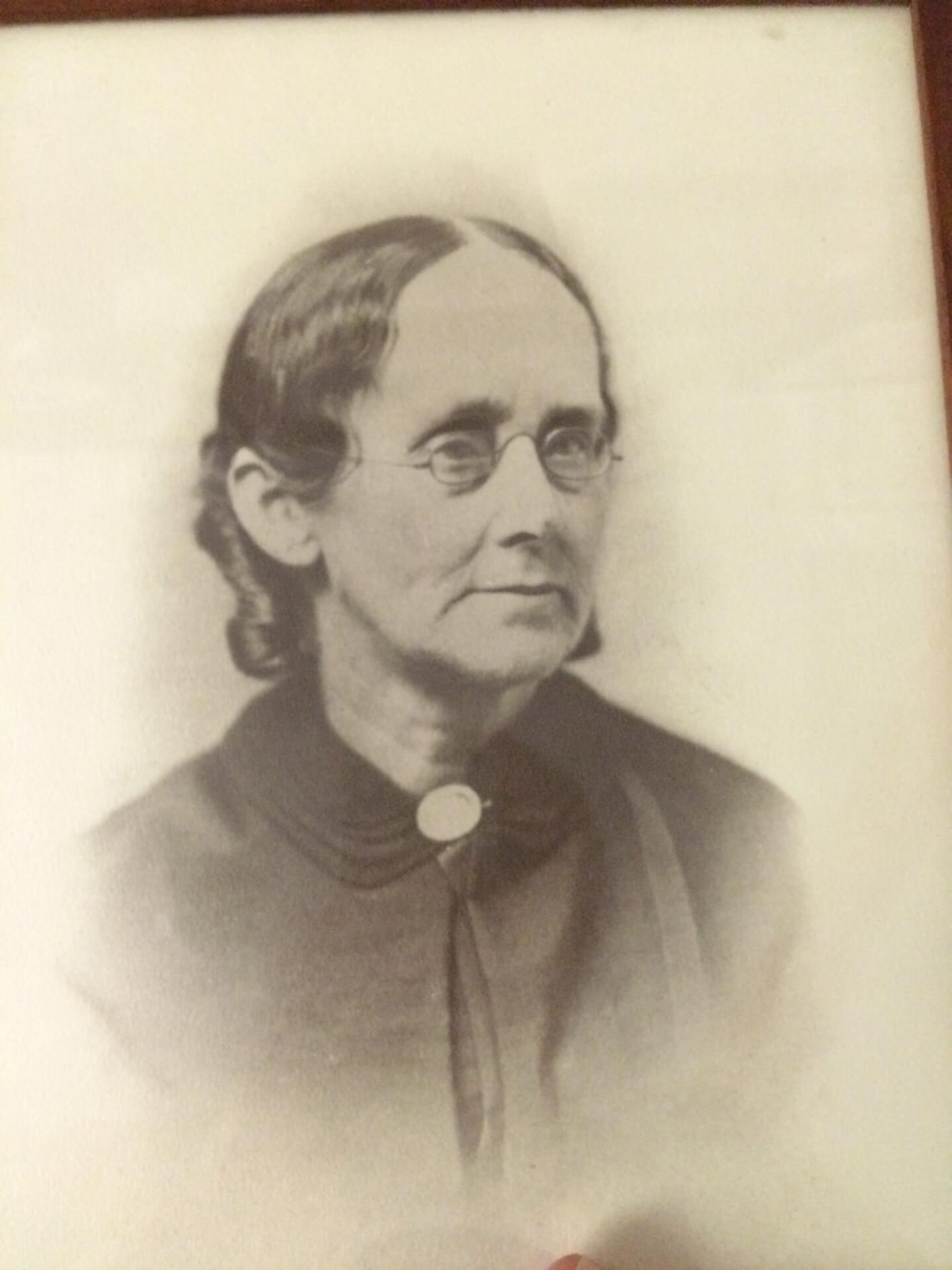
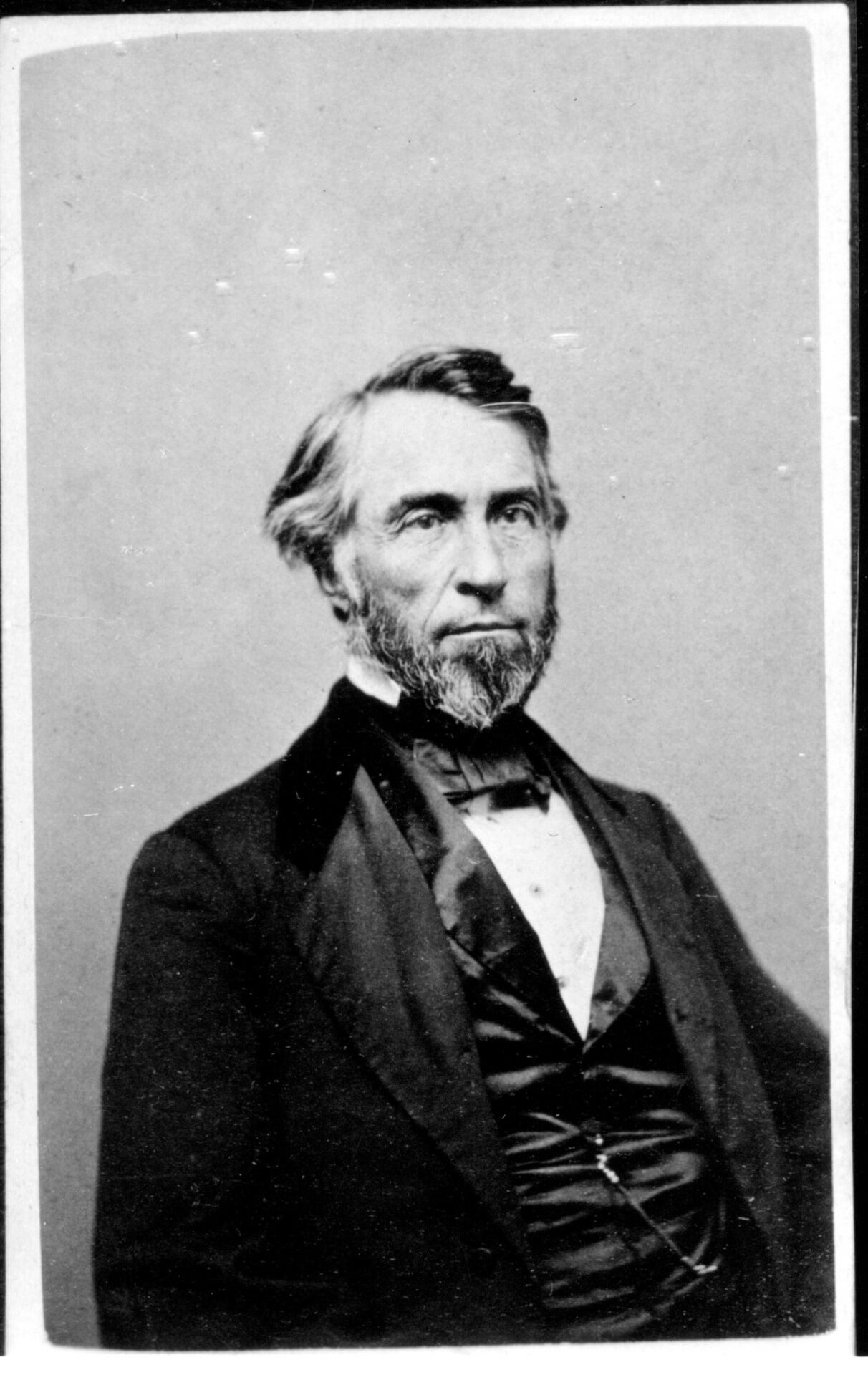
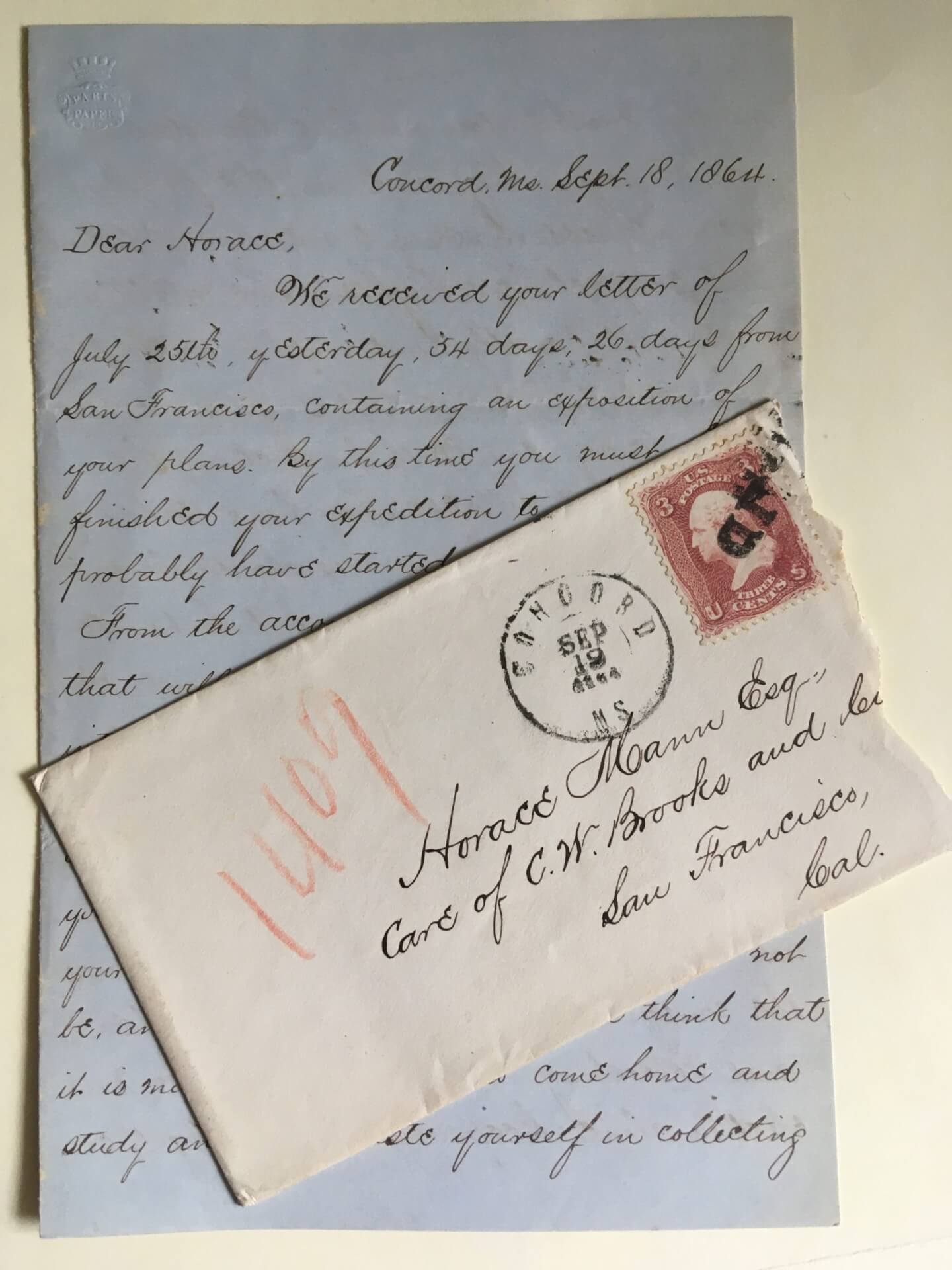
Like his mother, George is paying close attention to the news of the day, meaning the Civil War and the presidential election about to be held in the middle of it. He seems confident that the war’s recent progress will ensure the reelection of Abraham Lincoln and the end of the rebellion. Worth noting is the Wilkes he refers to as his source for information about Hawaii is Charles, a US Navy officer and explorer who led and published Voyage Round the World: Embracing the Principal Events of the Narrative of the United States Exploring Expedition in 1849. The highly controversial Wilkes, known for his harsh discipline and arrogant behavior, may have been Hermann Mellville’s chief inspiration for Captain Ahab. At the time of this writing, George is a Harvard undergraduate and relates seeing some classmates familiar to his brother including the son of Ralph Waldo Emerson.

Unless he is simply doing his mother’s bidding, George dismisses his brother’s rapidly growing expertise (“you don’t know much out of the scientific way”), suggesting that another specimen-gathering expedition will somehow result in Horace Jr.’s self-realization that his education is inadequate, which seems unlikely. According to George, Horace the Younger (as he often called himself), on the verge of becoming an international authority on plant life, should heed the worst kind of advice there is (unsolicited) and not pursue his dreams.

Concord, Ms., Sept. 18, 1864.

Dear Horace

     We received your letter of July 25th, yesterday, 54 days, 26 days from San Francisco, containing an exposition of your plans. By this time, you must have finished your expedition to Hawaii, and probably have started on the other one. From the account of Hawaii in Wilkes, that will undoubtedly be an extremely interesting trip. By the time you get back from the other voyage you will know if any arrangement has been made by which you can stay longer (such as you spoke of in your last letter), but I hope there will not be, and mother does too, for we think that it is much better for you to come home and study and not waste yourself in collecting merely. Mother does not like the idea of your staying so long, and, in the present circumstances, it seems to me I would not. The prospect here brightens. The McClellan party will possibly have a split, on the platform, and Lincoln’s re-election grows more certain every day. With his election, the rebellion will collapse. They have taken good care that their armies should be full, and they have always been full. Last winter they got everybody into the army, and the result was, that when the campaign opened, they seemed stronger than ever. But soon the losses began to tell. They did not have two millions of able-bodied men who had not been in the army, as we have now, and the consequence is that Atlanta has fallen, and Petersburg will. The hope of the Nov. election alone keeps their army together. If McClellan should be elected, everything would be lost, but he won’t be. I hope when you come home, it will be in peace. Then you know that you have not yet finished your education, and the sooner you go about it, the better. There is one thing which I think does a person more good than anything else, and that is a willingness to take advice, or at least to listen to it, and consider whether it is worth anything. To despise advice is to say “I know best” and to set yourself up as the best reasoning person in the world, or in one word “conceit,” and I know that that is not your style. Of course, one understands one’s own feelings and the circumstances he is in, best, but discuss the whole matter with some one for whose opinion you care, and you will find that “taking good advice” never hurts you. I hope when you answer this letter and the one which I know mother will write, that you will inform us that you are coming home soon. Of course the expedition will do you good, and perhaps, among other things, it will teach you that you don’t know much out of the scientific way, and show you how much better in every way it will be to have a general education, and not be one who knows nothing but Botany, Geology, &c. I don’t intend this as “good advice” but it is what everybody thinks, and what you will think in after years.

     College life has been quiet.  Sam, Edw. Emerson and I came up on Wed. eve. to Geo. Keyes’ tin wedding, and went back, via Lexington, in time for prayers. The same evening they had a lovely row in Cambridge, on the occasion of a party of McC. ites undertaking to raise a McClellan flag, and calling themselves the “Harvard McClellan Club.” I was sorry not to be there, but their old flag won’t stay there much after the moon has gone. Perhaps a very near relative of Ben will have Charley B. Davis’ McClellan flag in some room in Harvard College before the election. comes off. Good bye,

Your loving brother,
Geo. C. Mann

H. Mann, Pacific Ocean

Mary Mann

Horace Mann Jr.


“Songs From the Stacks” is a regular selection from Antiochiana: the Antioch College archives by College Archivist Scott Sanders.


More Songs From the Stacks

Mary Mann to Horace Mann Jr 18 Sep 1864 – Antioch College

Mary Mann to Horace Mann Jr 18 Sep 1864

Home » Campus News Latest » Antiochiana: Songs From the Stacks » Mary Mann to Horace Mann Jr 18 Sep 1864

From the department of Mother Knows Best comes Mary Mann, widow of Horace Mann, telling her son Horace Jr. not only what to do but how to live his life.

She complains that his last letter took nearly two months to reach her, perhaps not realizing just how far the Sandwich Islands are from Concord, MA (over 8000 miles as the crow flies, btw). For context, the First Transcontinental Railroad has only just begun construction and the Panama Canal is still decades away, lengthening the trip considerably. Rapidly developing into one of America’s premier botanists, Horace Jr. had gone to Hawaii in 1864 to survey its plant life. Accompanied by another young scientist, William Tufts Brigham,  together the two scholars identified over a hundred species previously unknown to Western science. This research would become Jr.’s senior thesis at Harvard (class of 1867) and his major published work, Enumeration of Hawaiian Plants.

Always a rich source of news, Mary catches her son upon the two main stories of the day, the US Civil War and the upcoming presidential election of 1864. Ringing familiar with current events in America, she deplores the twin evils of ignorance and selfishness as the root cause of “our country’s disaster.” Although she refers to slavery, her comments readily apply to the national disaster of 2020. Also familiar to moderns is her discussion of the national election, coincidentally the one most closely compared to today on the issue of mail-in voting. One of the major parties is in disarray and can be seen as representing an old order on its last gasp. In 1864 that party was the Democrats, running on a so-called “peace platform” formed at the National Convention in Chicago to end the war and leave slavery in a place where it still existed. Despite nominating former Union Army commander George B. McClellan for president (his running mate, George Pendleton of Cincinnati, was portrayed brilliantly and hateable by Scottish actor Peter McRobbie in Steven Spielberg’s 2012 film Lincoln), the peace platform was roundly rejected by the soldiers the general had once led, who voted nearly eighty percent in favor of the Republicans and Abraham Lincoln.

Once she concludes her gazetteer, Mary gets to what she really wants to say, which is that she does not approve of her son’s career aspirations. She seems unable to appreciate what he knows or can do, pointing out what he does not know and cannot do, at least by her estimation. She sees the collecting plant samples as menial and beneath his talents, not realizing that he was already assembling one of America’s great herbariums. At over 12000 items, collected over a relatively short period of time (for he died of tuberculosis at 24), Horace Jr.’s herbarium was the first of several acquisitions that became the famous Cornell University Herbarium, still regarded as one of the most significant collections of its kind in North America if not the world. If Mary’s plans for her sons were for them to make a lasting contribution as their illustrious father had done, his namesake was way ahead of her.

Concord, Sept. 18th, 1864

My dear Horace

Your letter of July 25th arrived yesterday, after being 51 days on the way. You see my date, and you will probably be on your trip with the missionaries before you receive this. The regularity of your letters since they first began to come has been very pleasant and comforting, tending to annihilate the sense of space very much, and it will be very dismal not to hear for five months. But if I can feel that you are ordinarily safe & doing a pleasant thing, I suppose I shall bear it decently. As I have said before, moral separations are the only absolute ones, and you are such a nice good child that I have no reason to fear that. I will keep your counsels safe, never fear, and hope you will never hesitate to write of things & people just as they are when you write to me. I will keep all your secrets.

Mr. Emerson (I have just discovered that I began this sheet on the wrong end) has been very curious to know what you would have to say about the revolution, so that I shall be sorry not to be able to tell him what you say, which is very significant and is the most important thing that could be told, for the moral aspects of such a question are the most important to a real philosopher. Ignorance is the source of half, perhaps of three quarters of the evils in the world – perhaps ignorance and selfishness may be said to divide the matter between them. I am sure we may read the riddle of our country’s disaster in that way, & I can remember nothing in history which does not exemplify it.

But you will be glad to hear that we are really looking up. You will have heard of the fall of Atlanta & the possession of Mobile harbor, & consequent stopping of blockade running there. But you will not have heard of the moral effect of the Chicago Convention of Democrats who nominated M’Clellan for the Presidency on a thorough peace platform, designed to give independence to the South & the continuation of Slavery where it still exists. The country waited a week breathless, to know whether M’Clellan, who has always been a war democrat, would eat his late plain words and accept it. At last he wrote a non-committal letter in which he accepted the nomination, but ignored the platform! At which a howl went through the party which will probably split by calling another convention & nominating Pendleton of Ohio, a pro-slavery copperhead rascal. The moral effect has been thus far to unite the Republicans almost to a man for Lincoln, & even Anna Dickinson and Mr. Brooks & many other abolitionists, Garrison having gone over to him long ago. Wendell Phillips may stand out, being heady. But N. Hampshire, Maine, Vermont & Mass., & also the soldiers vote wherever heard from, unite overwhelmingly upon Lincoln, all within a week. And Grant and Sherman both write fine letters urging the filling of the draft immediately, to finish up. Volunteers are pouring in, Gen. H. says grandly, while the Southern armies are getting depleted & can raise no more men.

Gold has gone down to 2.25, which is bad enough but better than 2.80. It is supposed that prices and exchange will long continue high – they always do long after a war. So you will not be likely to reap much benefit from the decline of gold. It will probably be long before it is at par again.

But there really seems to be a hope that the rebellion will soon be crushed by mere force of arms. If Lincoln is re-elected, of which few doubt now, the rebels will be completely discouraged. It is now seen by Southern papers that they have been hoping M’Clellan will be next President – they evidently know that he will give in to the real policy of the party. He is completely ruined with the soldiers now. So we have as much reason to be thankful for the Chicago Convention as for the Baltimore & Worcester one. Our good Gov. Andrew & indeed all the State ticket is renominated by acclamation and by ballot both, at Worcester last Thursday. I send you the speech of Mr. Bullock (the other candidate), it is so noble (I wish there was a telegraph for the ear that you might hear Georgie playing Maien Liebe (May love) & Silver Showers. He rushes to the piano when he gets home from Cambridge, as you do to a brook after being in the dry mountains).

I shall have to copy for you a story about Mr. Lincoln that is in a paper I cannot send you because it is not mine. He is an unpolished diamond if he is one, & perhaps after all Mr. Bullock is right & he remains to be fully appreciated because unpolished and not self-conceited. I hope so, I am sure, for the welfare of the nations.

I must now answer the other query in your letter – about staying longer. My own unbiassed opinion, taking your highest good into consideration, is that you should not remain there or go elsewhere to make collections. Before enlarging upon my reasons, I will premise that I will talk with Aunt Lizzie (who left me yesterday for her Winter campaign) and make all possible enquiries as to what may be done to facilitate such a plan as you suggest, because I will not decide so important a matter without advice. I think I shall speak of it to Mr. Emerson tonight in reference especially to your future welfare. My own feeling is that if you should stay away so long at your age, and in the present very limited condition of your acquirements, you would drop forever into the position of a mere drudge of science, a picker up of stones and scraper of skeletons, which is very far below my aspirations for you. You do thoroughly whatever you do, and I do not wish to disparage the value of what you know, but the very limited nature of it disqualifies you in my estimation from being a fair judge of the value of that which you do not know. You know nothing of modern history, not much even of your own country, and are not qualified to cast a vote when you return. You do not understand political economy or political science of any kind, and have no knowledge of general literature, ancient or modern. You could not converse with any clan of literary men or women, except strictly scientific men, & then not as an equal. I have no strictly worldly ambition for you, but I do wish to see a fair development of all your powers, and they have never yet had a common chance. I hope you will come home & study in the Scientific School at least, and attend lectures on other subjects, and read, & stop collecting, for it consumes oceans of time and is swallowing up the best part of yours. This monstrous expense has been a great evil, for it costs more than all you are doing is worth to you. When you are forty, and capable of judging for yourself where to go and what it is worth while to do, you can go again. Meantime, try to add something to your small means, for they are but a trifle in comparison to such demands as these upon you. I think everyone you know would respect you more if you should come home and turn student, either in or out of college, of many things that you have neglected – that you did not mean to neglect, but which you have not found time to do in connection with other things that you have done. I think you will have had quite a variety of experience when you return from that missionary trip, and enough to make use of for a long time, and perhaps work up into some presentable shape, with my assistance. I think the effect of dealing for a long time with a set of degraded people like those natives & the crews of vessels cannot be good upon a young person who always needs to be more or less in the presence of culture & refinement to become so or fit to have intercourse with them. I was very much struck with a remark Winthrop made about holding one’s own in the midst of the coarseness of the army. There are whole realms of knowldege yet unexplored by you, and you are not yet so old as your father was when he began to study his Latin grammar. You know vastly more than he did then, except of history which he had read a good deal. Think of Mr. Weston, who after being a settled minister fifteen years entered a Freshman class in college! And so of many others. I shall not insist upon your doing this, glad enough as I should be to have you, because I have promised you not to do so, but I shall be very glad if you want to, & shall feel that at forty you will fill a very different position from what you otherwise would. Mr. Fay was about to enter the Preparatory School at Antioch – and he has been the pupil of his wife in mathematics and English Composition.

I shall write you again in a few days, hoping to be in time before you leave in the missionary ship, which you say may be delayed till December.

Mary Mann

Horace Mann Jr.


“Songs From the Stacks” is a regular selection from Antiochiana: the Antioch College archives by College Archivist Scott Sanders.


More Songs From the Stacks

Mary Mann to Nathaniel Peabody – Antioch College

Mary Mann to Nathaniel Peabody

Home » Campus News Latest » Antiochiana: Songs From the Stacks » Mary Mann to Nathaniel Peabody
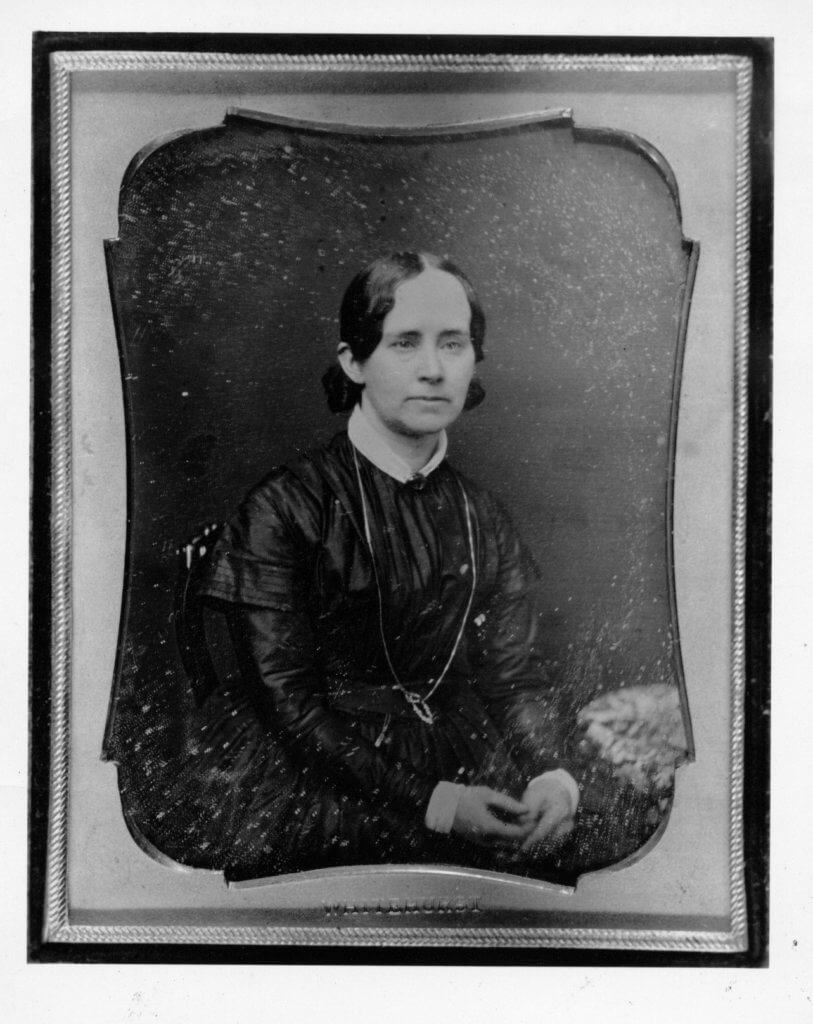
Mary Mann

Mary Peabody Mann

One of the best first-hand sources on life at Antioch College in its earliest days was the wife of its first president, Mary Peabody Mann. Her frequent letters home to her family in Boston, held by Antiochiana because of the tireless collecting efforts of Robert L. Straker (class of 1925), provide some of the greatest detail on the College’s opening day ceremonies, on the character and composition of its students, and of course its many trials and tribulations. Most of all, we learn from Mary’s letters what bothered her at any given time, which was much.

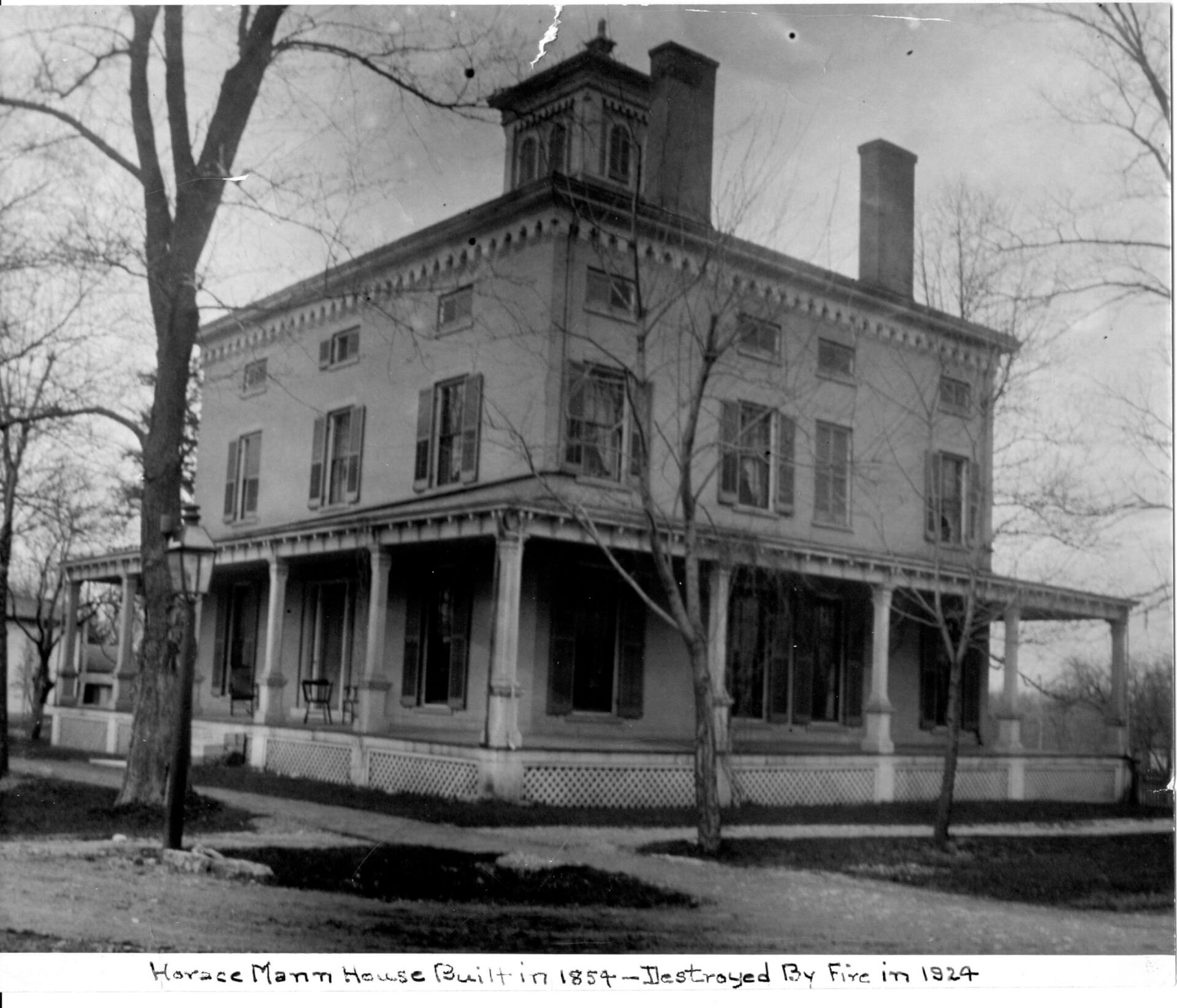
Here she writes to her father about the President’s House, a magnificent residence befitting any college president, and in this instance designed to the Manns’ specifications. A condition of her husband taking the job in the first place, it was supposed to be move-in ready when they arrived in Yellow Springs in late summer 1853. In fact nothing of Antioch was ready to be moved into by then, and work on the house had yet to begin. Over the next year, the Manns would long longingly for their home to be completed as evidenced by their correspondence. In a letter that November Horace wrote, “Ohio growths are rapid growths but this does not hold true of our house which has not yet grown up to the chamber [i.e. second] floor.” At the time, Mary wrote to Dr. Peabody, their house still did not have a roof.

Alpheus Marshall Merrifield

Alpheus Marshall Merrifield

There was a reason the Mann’s house wasn’t ready yet, though not an especially good one. The man in charge of building the original Antioch campus, one Alpheus Marshall Merrifield, didn’t particularly like the Manns. Trustee and Treasurer as well as chief builder, Merrifield and Mann had already clashed more than once on matters of College business in general and competing visions for Antioch in particular. Mann’s outlook, stated most explicitly in his “Demands of the Age On Colleges,” saw institutions of higher learning as having obligations beyond service to their constituencies. His immortal quote, “Be ashamed to die before you have won some victory for humanity,” might be seen as an abbreviation of that idea. By contrast, Merrifield saw Antioch’s role as advancing the founding denomination’s own versions of Christianity. The two men were never going to agree on that, and Merrifield’s not very mature way of arguing with Mann was to delay building the President’s House in any way he could, and it would take five more months before Horace and Mary finally had their own home.

March 10, 1854. Mrs. Mary Mann to Dr. Nathaniel Peabody. (RLS)

March 10th 1854

My dear father,

The president’s house at Antioch College, built for the Manns in 1854.

     It seems to me a great while since I wrote to you, but I think it cannot be a fortnight. I was suffering from a bad earache then, but it is all well now. I am still a little deaf, but otherwise well & free even from cold. The weather is very mild – some of the days are not only spring-like but summer-like, & the grass on the slope is beginning to turn green. We were afraid there would not be any, but it is difficult to root out any growths from this soil. You will be still more glad to hear that our house is fairly growing at last. It is going to be a very pleasant one. The room corresponding to Mr Mann’s library in the other house will be our best parlour, & his study where our best parlour was – both larger rooms than those in the other house. These are connected by folding doors with no chimney between – the chimneys are on the south side, corresponding with the West Newton piazza (this house faces west). Our dining room will be opposite the front door as in the other house, but much larger. The room corresponding to the bed room below is a large sitting room – the one corresponding to the West Newton kitchen a room of closets & a place where I intend to have every body come in (through a door leading from the piazza) who has muddy shoes on, or wishes to deposit a hat or other garment. It is a room which will save the front entry very much.The sitting room on that side has a very beautiful view of the village, which is very picturesque standing on the skirts of a forest. Over that sitting room is my chamber, and over that waste room just mentioned a bathing room of goodly dimensions – the communication between them is through two large closets. Water closet in the corner of the house adjoining the bathing room. Over the best parlour is the best chamber where the nursery was in the old house. Miss Pennell will have her room while she remains in single blessedness. Over the dining room I shall put Benjie & Georgie. In the third story are five airy pleasant chambers, two of them quite large, with windows in the roof which slopes up from four sides to an observatory which will be accessible by a good pair of stairs – these rooms are also lighted by oblong windows which come down to the floor. There will be a piazza all round the house except behind, & windows cut down to it. The basement story which is high and can hardly be called a cellar on one side is floored by solid limestone – on the lowest side is the kitchen – on one side of the kitchen a large store room – on the other a wood-room – in the middle room a furnace in which we shall burn wood. Under the best parlour a vegetable room – under the study an apartment nicely finished off for a boy. This will be a very pretty room & all this story will be perfectly dry. To prevent the possibility of dampness a drain is dug which together with the drain for waste house water opens into a large reservoir in the garden, which will be thus irrigated. Water from the eaves is to be conducted into a cistern in the upper story from which it is to be conducted by pipes down into the bathing room and other chambers. A large cistern out of doors will bring water into the house for washing, & spring water for other purposes will also be brought in.

     I have not another moment for I have been interrupted, but I will send this to assure you of our well being & with love to all to enquire after yours.

Yours affectionately

Mary


“Songs From the Stacks” is a regular selection from Antiochiana: the Antioch College archives by College Archivist Scott Sanders.


More Songs From the Stacks

This site is not affiliated with Antioch College, Antioch University, or the Antioch College Alumni Association. It is provided as a service to the Antioch College community to provide resources to inform people about the current situation at the college and what can be done to save the college before it's too late.